
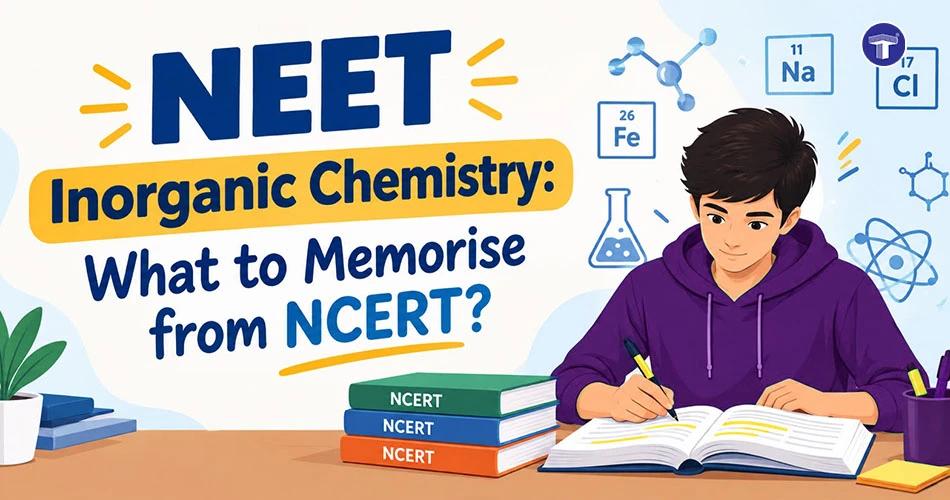
Many students ask, is NCERT enough for NEET Inorganic Chemistry? The practical answer is that NCERT should be your first and most important source. Inorganic Chemistry in NEET often needs strong memory, repeated reading and careful attention to small details.
Let’s know how to study Inorganic Chemistry for NEET and what you should memorise from NCERT without getting confused.
Why Inorganic Chemistry Feels Difficult
Inorganic Chemistry in NEET feels difficult because many topics look similar.
Common problems include:
| Problem | What Happens |
| Reading only once | Facts are forgotten quickly |
| Ignoring exceptions | MCQs become confusing |
| No revision cycle | Chapters do not stay in memory |
| Skipping NCERT lines | Direct questions feel unexpected |
| Learning randomly | Topics get mixed |
The solution is repeated NCERT reading with smart notes and regular MCQ practice. To understand how NCERT supports NEET preparation, read is NCERT enough for NEET guide.
NEET Inorganic Chemistry: What to Focus On
For NEET Inorganic Chemistry, focus on syllabus-based NCERT chapters and repeated revision.
Important areas usually include:
- Classification of Elements and Periodicity
- Chemical Bonding
- Coordination Compounds
- p-Block Elements
- d and f-Block Elements
- Hydrogen
- s-Block Elements
- Environmental Chemistry, if included in the official syllabus
- Practical Chemistry-related points
To identify high-priority chapters across subjects, read NEET important chapters 2027 guide.
How to Read Inorganic Chemistry for NEET
If you want to know how to read Inorganic Chemistry for NEET, do not read it like a story.
Use this method:
- Read one topic slowly.
- Underline trends and exceptions.
- Mark reactions and compounds.
- Write short memory notes.
- Solve MCQs from the same topic.
- Re-read the NCERT lines linked to wrong answers.
This makes reading useful and exam-focused. For chapter-wise MCQ practice after NCERT reading, you can use NEET UG topic-wise test series with solutions.
What Should You Memorise from NCERT?
In Inorganic Chemistry, memorisation should be selective but repeated.
Focus on:
| NCERT Area | What to Memorise |
| Periodic Trends | Atomic size, ionisation energy, electronegativity |
| Chemical Bonding | Hybridisation, shapes, bond order, exceptions |
| p-Block | Compounds, oxides, acids, reactions and trends |
| d and f-Block | Colours, oxidation states, magnetic behaviour |
| Coordination Compounds | Ligands, isomerism, nomenclature and bonding |
| Practical Chemistry | Tests, observations and important reagents |
For Chemistry revision and MCQ practice, NEET UG and JEE Mains Chemistry Absolute Vol. 1 book can support chapter-wise preparation.
How to Memorise NCERT Inorganic Chemistry Faster
Students often ask how to memorise NCERT Inorganic Chemistry faster. The best method is spaced revision.
Use this cycle:
| Revision Time | What to Do |
| Same Day | Revise highlighted NCERT lines |
| After 2 Days | Revise short notes and tables |
| After 1 Week | Solve MCQs and check mistakes |
| After 15 Days | Re-read difficult NCERT lines |
| Before Test | Revise charts, reactions and exceptions |
This is better than reading the whole chapter again without a plan.
Inorganic Chemistry Tricks for NEET
Inorganic Chemistry tricks for NEET can help, but only after you understand the topic.
Useful tricks include:
- Make trend tables.
- Group similar compounds together.
- Use colour-coded notes for exceptions.
- Revise one block at a time.
- Connect reactions with observations.
- Make one-page charts for p-Block and d-Block.
- Practise MCQs immediately after revision.
Tricks should reduce confusion, not replace NCERT reading. To avoid depending only on shortcuts, read a detailed guide on mistakes to avoid in NEET preparation.
Inorganic Chemistry Chapters for NEET
Students searching for Inorganic Chemistry chapters for NEET should use the official syllabus as the final list.
A simple preparation order can be:
| Order | Chapter Type | Why This Order Helps |
| 1 | Periodic Table | Builds trend understanding |
| 2 | Chemical Bonding | Helps in many other chapters |
| 3 | Coordination Compounds | Needs concept plus memory |
| 4 | p-Block | Needs repeated NCERT reading |
| 5 | d and f-Block | Needs oxidation states and colour revision |
| 6 | Practical Chemistry | Useful for observation-based questions |
If your Chemistry basics are weak, the best NEET UG preparation books guide can help you choose suitable study resources
Inorganic Chemistry Syllabus for NEET
The Inorganic Chemistry syllabus for NEET should not be guessed from random online lists. Check the official NEET syllabus and then match it with your NCERT chapters.
After checking the syllabus, make three lists:
- Completed chapters
- Weak chapters
- Revision-heavy chapters
This helps you revise based on need, not fear. For full syllabus planning, you can also read the best books for NEET 2027 preparation.
How to Prepare Inorganic Chemistry for NEET
If you want to know how to prepare Inorganic Chemistry for NEET, use this simple method for every chapter:
- Read NCERT.
- Understand trends.
- Mark exceptions.
- Make short notes.
- Solve MCQs.
- Practise PYQs.
- Revise wrong questions.
Do not read too many books before completing NCERT. Extra material should support your NCERT preparation.
How to Revise Inorganic Chemistry for NEET
Many students ask how to revise Inorganic Chemistry for NEET because they forget it quickly.
Use short revision blocks:
- 20 minutes for NCERT highlighted lines
- 15 minutes for charts and tables
- 20 minutes for MCQs
- 10 minutes for wrong-answer review
This is more effective than reading for 3 hours without testing yourself.
Important Links
| Physical Chemistry Formula Sheet for NEET: The Ultimate Key | How to Analyse NEET Mock Test Mistakes Effectively |
Final Advice
NEET Inorganic Chemistry becomes easier when you treat NCERT as the main source and revise it regularly. Memorise trends, exceptions, reactions, colours, compounds and NCERT tables, but also solve MCQs to test your memory.
Do not study Inorganic Chemistry randomly. Follow the official syllabus, read NCERT line by line and keep short notes for quick revision.
FAQs
1. Is NCERT enough for NEET Inorganic Chemistry?
Ans: NCERT is the main base for NEET Inorganic Chemistry. However, students should also solve MCQs, PYQs and mock tests to improve application and accuracy.
2. How should I study Inorganic Chemistry for NEET?
Ans: Start with NCERT, understand trends, mark exceptions, make short notes, solve MCQs and revise wrong answers regularly.
3. How can I memorise NCERT Inorganic Chemistry faster?
Ans: Use spaced revision. Revise the same topic on the same day, after 2 days, after 1 week and before tests. Make short charts for quick recall.
4. Which Inorganic Chemistry chapters are important for NEET?
Ans: Chemical Bonding, Periodic Table, p-Block, d and f-Block and Coordination Compounds are important. Still, follow the official syllabus and do not skip chapters blindly.
5. What are the best Inorganic Chemistry tricks for NEET?
Ans: Use trend tables, reaction charts, colour-coded exceptions, one-page revision notes and MCQ-based recall. Tricks work best when NCERT reading is already strong.
6. How should I revise Inorganic Chemistry before NEET?
Ans: Revise highlighted NCERT lines, short notes, tables, reactions, colours and wrong MCQs. Keep revision short but frequent.