
Knowing the answer but leaving it unanswered because you spent too long on another question is a common MHT CET problem. The solution is not to rush. Effective MHT CET time management means knowing when to solve, when to skip, and when to return to a question.
The MHT CET exam is 180 minutes long. In PCM, you solve 150 questions, while PCB has 200 questions. There is no negative marking, but the paper is divided into two fixed 90-minute groups, making time discipline essential.
Understand Your Time Before You Start
For MHT CET, the first 90 minutes are reserved for Physics and Chemistry for both PCM and PCB. After 90 minutes, that group is automatically submitted. The next 90 minutes are for Mathematics in PCM and Biology in PCB. You cannot carry unused time from one group into the next.
This makes your MHT CET section-wise time allocation especially important.
- PCM: First 90 minutes – Physics + Chemistry; next 90 minutes – Mathematics.
- PCB: First 90 minutes – Physics + Chemistry; next 90 minutes – Biology.
Do not treat these as rigid subject-wise limits. Your ideal allocation should depend on your accuracy, familiarity and solving speed.
Use a Simple 3-Pass Strategy
A three-pass approach can make your MHT CET paper time management much more effective.
Pass 1 – Quick wins:
Start with questions where you immediately recognise the concept and know the approach. Solve these confidently without overthinking.
Pass 2 – Moderate questions:
Return to questions that require calculations, multiple steps or slightly more thought. Work through them carefully.
Pass 3 – Time-consuming questions:
Finally, attempt questions that involve lengthy calculations or concepts you initially found unclear. By this stage, you have already secured the questions you could solve efficiently.
To practise this approach, you can refer to Target Publications’ Triumph Series for MHT-CET, which categorises MCQs into Easy, Moderate and Difficult levels, helping you gradually build speed, accuracy and confidence across different question types.
How Much Time Should You Spend on One Question?
There is no single ideal MHT CET time per question. A calculation-heavy Mathematics question cannot be compared directly with a straightforward Chemistry or Biology question.
Instead of constantly calculating your average time per question, use time checkpoints. For example, during practice, check your progress every 20–30 minutes. Ask yourself:
- How many questions have I attempted?
- How many are still pending?
- Am I spending too much time on one type of question?
- Is my accuracy dropping because I am rushing?
This gives you a realistic picture of your speed without making you obsessed with the clock.
Use the “60-Second Decision” Rule
If you have spent around a minute on a question and still cannot identify a clear approach, make a decision: move ahead and return later if time permits.
This is particularly useful for questions involving:
- Repeated calculations
- Multiple attempts at the same method
- Re-reading the question several times
- Uncertainty between multiple approaches
The 60-second rule is not a command to abandon every difficult question after exactly one minute. It is a decision-making checkpoint designed to prevent one question from consuming disproportionate time.
PCM vs PCB: Plan Differently
For MHT CET PCM time management, Mathematics deserves careful planning because each Mathematics question carries 2 marks, while Physics and Chemistry questions carry 1 mark each.
For example, during the first 90-minute Physics-Chemistry block, you might initially plan about 40–45 minutes for Chemistry and 45–50 minutes for Physics, depending on your strengths. The following 90 minutes are exclusively for Mathematics.
For MHT CET PCB time management, the second 90-minute block contains 100 Biology questions. Since Biology has more questions to cover, your strategy should prioritise quick recognition and avoid spending excessive time on individual questions.
These are starting points, not mandatory formulas. Test different allocations in your mocks and use the one that produces your best combination of speed and accuracy.
Build MHT CET Time Management Through Mock Tests
Reading MHT CET time management tips is not enough. You need to practise under actual time pressure.
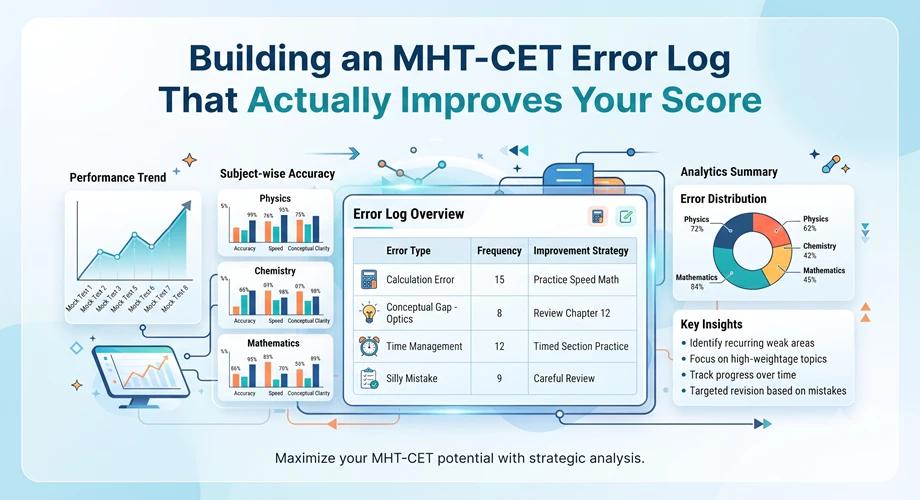
A full-length MHT CET mock test for exam-like practice can help you identify where your time goes. After every test, record:
- Questions attempted
- Questions left unanswered
- Average solving speed
- Time spent on difficult questions
- Accuracy under time pressure
- Subject or question types causing delays
You can also use Target Publications' MHT-CET practice papers and test-series resources to build regular timed practice into your preparation.
For additional practice, MHT-CET previous-year solved papers can help you become familiar with recurring question styles and practise solving within a controlled time limit.
Common MHT CET Time-Management Mistakes
Avoid these common mistakes:
- Spending several minutes trying to crack one difficult question
- Starting with the most challenging questions
- Checking the clock after every few questions
- Rushing through easy questions and making avoidable errors
- Practising only chapter-wise questions instead of full-length timed papers
- Taking mocks without analysing where time was lost
- Using the same time strategy even when your mock-test data shows a recurring problem
For more preparation guidance, refer to MHT-CET practice paper strategies and build your approach around your actual performance.
Your MHT CET Time-Management Strategy Starts in the Next Mock
Better MHT CET exam time management comes from three things: timed practice, intelligent question selection and analysing where your time goes.
Start with a simple cycle:
Take a timed test → analyse your time → identify your biggest time leak → adjust your strategy → repeat. The goal is not simply to solve faster. It is to solve the right questions at the right time, with accuracy and control.
Important links
| MHT-CET Practice Papers Explained: Importance and Usage Tips | MHT CET Previous Years’ Question Papers (2020–2025). Free PDF Download |
FAQs
1. How can I improve my MHT CET solving speed?
Practise regularly with timed question sets and full-length mock tests. Analyse your performance after each test to identify questions or topics where you are losing time, then work specifically on those areas.
2. How should PCM students manage time in MHT CET?
PCM students have 90 minutes for Physics and Chemistry followed by 90 minutes exclusively for Mathematics. During the first block, plan your time between Physics and Chemistry according to your solving speed and accuracy, while keeping the second block focused on Mathematics.
3. How should PCB students manage time in MHT CET?
PCB students have 90 minutes for Physics and Chemistry followed by 90 minutes for Biology. Since Biology contains a larger number of questions, focus on quick recognition, efficient solving and avoiding unnecessary time spent on individual questions.
4. How can mock tests help with MHT CET time management?
Mock tests help you practise under exam-like time pressure and identify where you lose time. Track questions attempted, unanswered questions, solving speed, accuracy and the types of questions that cause delays.