
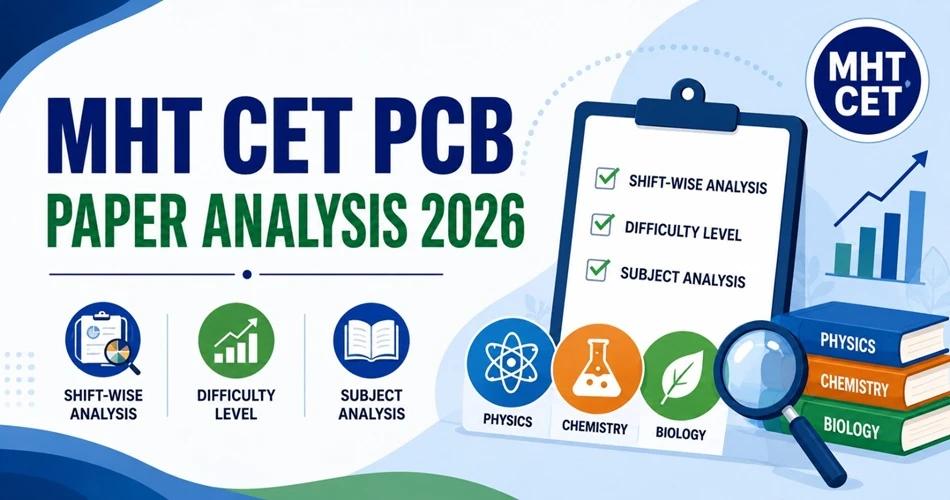
The MHT CET PCB paper analysis 2026 helps you understand the exam's overall difficulty, subject-wise trends, expected good scores and what to expect during the admission process. Reviewing the paper analysis also helps you compare your performance with different shifts and estimate your probable percentile.
Before diving into the analysis, staying updated with official notifications is equally important. The Education News WhatsApp Channel by Target Publications provides timely updates on answer keys, result announcements, counselling dates and admission news. Alongside this, the Tayari App offers mock tests, previous year papers, quizzes and revision material that can strengthen your preparation for future attempts or other competitive examinations.
MHT CET PCB 2026 Exam Overview
The MHT CET PCB 2026 exam analysis indicates that the paper maintained a balanced approach across all shifts. While a few sessions were slightly more challenging, the overall difficulty remained comparable, ensuring fairness through the normalisation process.
MHT CET Paper Pattern PCB
Understanding the MHT CET paper pattern PCB helps you interpret the analysis better.
| Subject | Question | Marks |
| Physics | 50 | 50 |
| Chemistry | 50 | 50 |
| Biology | 100 | 100 |
| Total | 200 | 200 |
MHT CET PCB Marking Scheme
The MHT CET PCB marking scheme remained unchanged in 2026.
- 1 mark for every correct Physics question
- 1 mark for every correct Chemistry question
- 1 mark for every correct Biology question
- No negative marking
The CET marks distribution for PCB continued to give Biology the highest weightage with 100 marks.
MHT CET PCB Shift Wise Analysis
The MHT CET PCB shift wise analysis revealed only minor differences across sessions.
| Shift | Overall Difficulty |
| Early Shift | Easy to Moderate |
| Mid Shifts | Moderate |
| Later Shifts | Moderate to Slightly Difficult |
Many candidates always discuss which was the MHT CET PCB toughest shift and MHT CET PCB easiest shift. However, no shift had a significant advantage because percentile calculation is based on the normalisation process rather than raw marks alone.
MHT CET PCB Question Paper Analysis
The MHT CET PCB question paper analysis showed that the paper closely followed the prescribed syllabus. Most questions were concept-based with a healthy mix of direct, numerical and application-oriented problems.
MHT CET PCB Physics Analysis
The MHT CET PCB physics analysis suggests that Physics remained the most time-consuming section.
Key observations:
- Greater emphasis on conceptual understanding
- Numerical questions required accurate calculations
- Modern Physics and Current Electricity were well represented
- Formula-based questions were comparatively fewer
Overall difficulty: Moderate to Difficult
MHT CET PCB Chemistry Analysis
According to the MHT CET PCB chemistry analysis, Chemistry was balanced and largely NCERT-oriented.
Important highlights:
- Organic Chemistry had straightforward questions
- Physical Chemistry included calculation-based problems
- Inorganic Chemistry focused on factual concepts
- Direct theory questions were seen across all shifts
Overall difficulty: Easy to Moderate
MHT CET PCB Biology Analysis
The MHT CET PCB biology analysis indicates that Biology remained the scoring section.
Candidates observed:
- Most questions were directly based on the prescribed textbook
- Diagrams and scientific terminology played an important role
- Genetics, Human Physiology and Ecology received good weightage
- Statement-based questions tested conceptual clarity
Overall difficulty: Easy to Moderate
Tip For Future Attempts: Take mock tests for PCB at home in the last one month for better results.
MHT CET PCB Difficulty Level
The overall MHT CET PCB difficulty level can be summarised as follows:
| Subject | Difficulty |
| Physics | Moderate to Difficult |
| Chemistery | Easy to Moderate |
| Biology | Easy to Moderate |
| Overall | Moderate |
Although discussions around the MHT CET PCB toughest shift continued after every session, the differences were not substantial enough to affect admissions due to percentile normalisation.
MHT CET PCB Answer Key
The provisional MHT CET PCB answer key is generally released shortly after the examination. You should carefully compare your responses with the official key, calculate your expected score and report any discrepancies within the objection window. The final answer key is published after reviewing all valid objections and forms the basis for result preparation.
Conclusion
The MHT CET PCB paper analysis 2026 shows that the examination remained balanced and syllabus-focused across all shifts. Biology continued to be the highest-scoring section, Chemistry remained straightforward for well-prepared candidates and Physics required stronger conceptual understanding. Rather than worrying about the MHT CET PCB easiest shift or MHT CET PCB toughest shift, concentrate on your percentile, as admissions depend on the normalised score. Use the subject-wise analysis, answer key and previous year papers to strengthen your preparation for future examinations and counselling.
FAQs
1. How does the MHT CET normalization process affect PCB percentile scores?
Ans: Normalisation adjusts scores across different shifts to ensure fairness. Your percentile is calculated by considering the relative performance of candidates in your shift.
2. Can students request a re-evaluation of MHT CET PCB results?
Ans: No. The CET Cell does not allow re-evaluation of answer sheets. However, you can challenge the provisional answer key during the objection window.
3. What happens if there is an error in the MHT CET PCB response sheet?
Ans: You should immediately report the issue through the official grievance process within the stipulated timeline after the response sheet is released.
4. Is the MHT CET PCB percentile more important than raw marks during admissions?
Ans: Yes. Admissions are based primarily on percentile scores and the merit list rather than raw marks.
5. How are tie-breakers resolved in the MHT CET PCB merit list?
Ans: Tie-breakers are resolved according to the Maharashtra CET Cell's prescribed rules, considering subject-wise scores and other criteria specified in the admission guidelines.
6. Does the difficulty level of a shift directly affect college admissions?
Ans: No. Since percentile scores are normalised across shifts, a tougher or easier shift does not directly influence your admission prospects.
Important Links
| How to Prepare for Class 12 Boards and MHT CET Together | MHT CET 2027 Strategy for Class 11 Students: The Smart 2-Year Roadmap to Score High |