
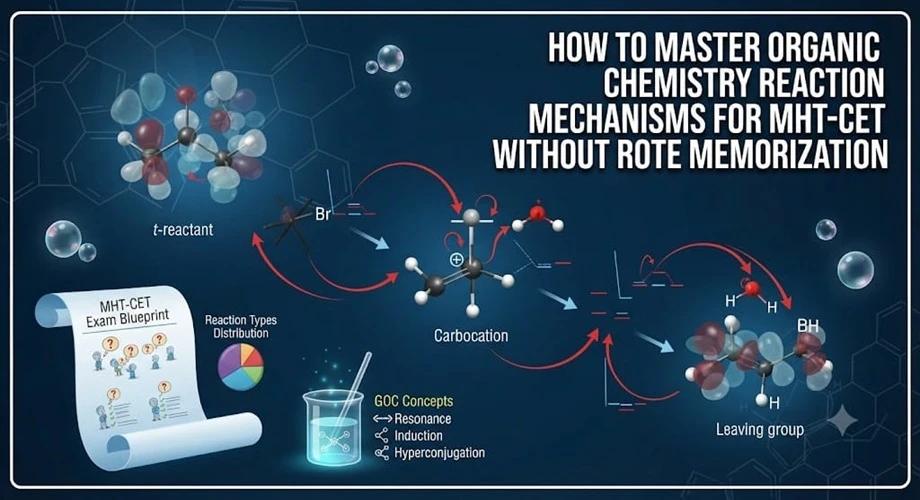
Organic Chemistry can seem difficult when you try to remember every reaction separately. The better approach is to understand why a reaction happens, what changes during the process and how different reactions are connected. For effective MHT CET organic chemistry preparation, this approach can help you solve unfamiliar questions instead of depending entirely on memory. If you want quick updates about exam dates, preparation strategies and other education-related information, you can follow the Education News by Target Publications WhatsApp channel. For structured practice, revision and exam preparation, the Tayari App can also help you organise your daily study routine.
Start With GOC
A strong understanding of General Organic Chemistry (GOC) makes reaction mechanisms much easier. Your MHT CET GOC preparation should cover concepts such as inductive effect, resonance, hyperconjugation, acidity and basicity, electrophiles, nucleophiles and reaction intermediates.
Instead of memorising definitions, ask yourself how electrons are moving. This helps you understand why a particular bond breaks, which atom gets attacked and why one product is favoured over another.
When reviewing the MHT CET organic chemistry syllabus, identify the concepts that appear repeatedly across different chapters. A strong foundation can make subsequent reactions easier to connect.
Understand Electron Movement
The key to learning organic chemistry reaction mechanisms is understanding electron movement. In most reactions, electrons move from an electron-rich site towards an electron-deficient site.
When you see a reaction, identify:
- The electron-rich species or nucleophile
- The electron-deficient species or electrophile
- The bond that breaks
- The bond that forms
- The intermediate, if any
- The final product
Following this sequence is more useful than trying to memorise the entire reaction as a single statement.
Build Reaction Connections
Instead of maintaining a separate list for every reaction, group MHT CET organic chemistry reactions according to their patterns.
For example, reactions can be studied through transformations such as substitution, addition, elimination and oxidation-reduction. Once you recognise the reaction type, you can recall the conditions and likely products more easily.
This is also useful when learning how to understand organic chemistry mechanisms. Ask what structural change has taken place rather than simply asking what the reaction is called.
Use Reaction Maps
Create a reaction map for each major organic chemistry topic. Place the starting compound on one side and connect it to possible products using arrows. Write important reagents and conditions above the arrows.
A visual map allows you to revise several connected reactions at once. Your MHT CET organic chemistry notes can therefore become a network of concepts rather than pages of isolated reactions.
Keep the maps short. Include only the reagent, condition, reaction type and key transformation.
Practise MCQs Strategically
Reading reactions repeatedly is not enough. Solve MHT CET organic chemistry MCQs after learning each mechanism.
When you make a mistake, do not simply mark the correct option. Identify why your answer was wrong. Did you miss the reagent, misunderstand the mechanism or choose the wrong reaction type?
You should also practise MHT CET organic chemistry PSPs. Previous-year questions can help you understand how concepts are tested and whether you can apply a mechanism under time pressure.
Learn Faster Through Patterns
If you are wondering how to learn organic chemistry reactions fast, focus on similarities between reactions instead of memorising each one independently.
Similarly, when thinking about how to memorize organic reactions, use active recall. Close your notes and try to reproduce the reaction, reagent and product from memory. Then check your answer.
Another useful method is spaced revision. Revisit reactions after a day, several days later and again after a longer interval. This reduces the need for last-minute memorisation.
Create Shortcuts Carefully
MHT CET organic chemistry shortcuts can save time, but they should support understanding rather than replace it. Use short codes, reaction families and trigger words for frequently confused reagents.
For example, make a small revision list of reagents that commonly cause oxidation, reduction, substitution or elimination. Always connect the shortcut to the underlying reaction pattern.
Follow a Daily Practice Routine
Your MHT CET chemistry preparation can include a simple daily cycle:
- Revise one mechanism for 15–20 minutes.
- Reconstruct the reactions without looking at your notes.
- Solve 10–15 related MCQs.
- Review every incorrect answer.
- Revisit older reactions for spaced revision.
This routine also answers how to study organic chemistry efficiently: learn, recall, practise and review rather than repeatedly reading the same material.
FAQs
How can I learn organic chemistry reactions without rote memorisation?
Understand the reaction mechanism, electron movement, reagents and structural transformation. Then practise recalling the reaction without looking at your notes.
How can I learn organic chemistry reactions fast?
Group reactions by mechanism and transformation. Use reaction maps, active recall and MCQs instead of memorising isolated equations.
Are previous-year questions or previously solved papers useful for MHT CET Organic Chemistry?
Yes. MHT CET organic chemistry PSPs can help you practise applying concepts and identify commonly tested reaction patterns.
Should I make separate organic chemistry notes?
Yes. Keep concise MHT CET organic chemistry notes containing mechanisms, reagents, conditions, reaction patterns and common mistakes.
What should I study first for Organic Chemistry?
Start with GOC and build a clear understanding of electron movement, electrophiles, nucleophiles, resonance and reaction intermediates before progressing to complex reactions.
Important Links:
| MHT CET 22 Model Question Papers: Your Smartest Way to Prepare for MHT CET 2027 | MHT CET Notes vs Textbooks: What Should You Prioritize |