
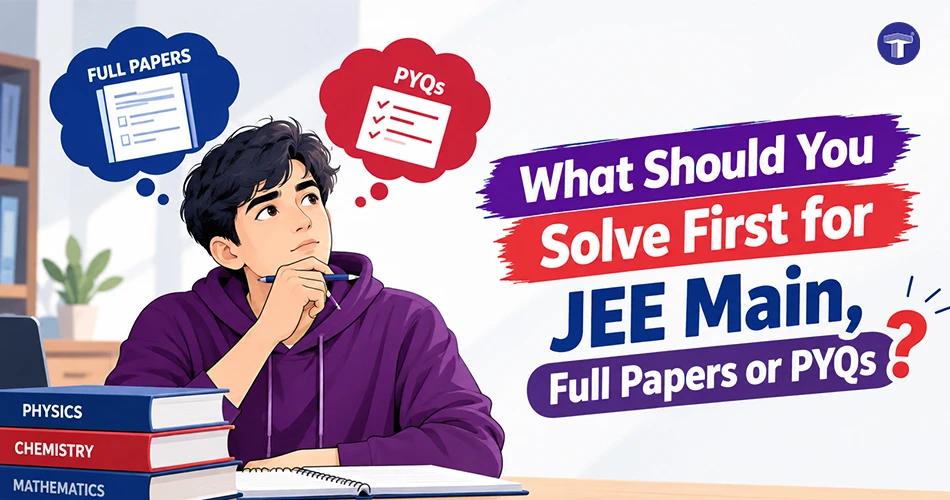
JEE Main previous year questions are one of the best ways to understand the exam pattern. But many students get confused about whether they should solve JEE Main chapter-wise previous year questions first or directly attempt full length previous year papers?
The answer depends on your preparation stage. If you are still developing concepts, start with JEE Main PYQ chapterwise practice. If your syllabus is complete, move to full length mock tests.
Both are important, but using them at the right time makes your preparation more effective. For direct previous year paper practice, you can use JEE Main question papers.
Chapter Wise PYQs And Full Test: Which Is Better?
Chapter wise PYQs and full test practice serve different purposes. One helps you build fundamentals while the other builds exam readiness.
| Practice Type | Best Time To Use | Main Benefit |
| Chapter-wise PYQs | Chapter-wise PYQs | Checks topic understanding |
| Subject-wise PYQs | After completing multiple chapters | Builds subject confidence |
| Full length previous year papers | After syllabus completion | Builds exam stamina |
| Full mock tests | Final preparation phase | Improves time management |
So, the question is not which is better. The real question is the sequence in which you should solve them.
To plan daily question targets better, read JEE Main 2027 daily question-solving guide.
Why Start With JEE Main PYQ Chapterwise Practice: Importance
JEE Main PYQ chapterwise practice is useful because it connects theory with exam-style questions immediately. It also helps you identify weak topics before they become a backlog.
For example, if you finish Current Electricity, solve chapter-wise PYQs from that topic. If you finish Chemical Bonding, solve PYQs from that chapter. This makes revision stronger and helps you remember concepts for longer.
| Chapter-Wise PYQ Benefit | How It Helps |
| Topic clarity | Shows whether the chapter is understood |
| Better revision | Helps recall key concepts |
| Error detection | Finds weak topics/subtopics early |
| Confidence | Makes exam-level questions less scary |
| Practice structure | Prevents random solving |
To decide which chapters need more PYQ practice, read JEE Main 2026 chapter-wise weightage guide.
When To Move To JEE Main Full Length Previous Year Papers
You should move to JEE Main full length previous year papers when you have completed most of the syllabus. Full papers test your ability to handle Physics, Chemistry, and Mathematics together under time pressure.
A full length paper tests stamina, speed, question selection, and time management. If you attempt full length papers too early, your score may remain low because you haven’t learnt all the topics. To understand repeated topic trends before attempting full papers, read JEE previous year chapter-wise trends guide.
How To Solve PYQs For JEE Mains Step By Step
If you want to know how to solve PYQs for JEE Mains, follow a proper sequence instead of solving randomly.
| Step | What To Do |
| Step 1 | Complete chapter theory |
| Step 2 | Revise formulae, reactions, or short notes |
| Step 3 | Solve chapter-wise PYQs without help |
| Step 4 | Mark wrong and doubtful questions |
| Step 5 | Read solutions and revise the concept |
| Step 6 | Reattempt marked questions after a few days |
This method turns PYQs into a learning tool. For a strategic approach, read how to use PYQs the right way for JEE Main.
How Many PYQs Should I Solve For JEE Mains?
There is no fixed number for every student. Your target should depend on chapter importance, weak areas, and available time. However, you should solve enough PYQs to understand the common question patterns and difficulty level. Quality matters more than only finishing a large number. Analyse every wrong answer.
JEE Main Full Length Mock Test Vs Previous Year Paper
A JEE Main full length mock test and a previous year paper are both important for exam preparation, but they serve different purposes. Previous year papers (PYQs) help students understand the actual exam difficulty, question patterns, and frequently tested concepts. Mock tests provide additional exam-like practice to improve speed, accuracy, and time management.
A full-length mock test simulates the JEE Main exam environment, which allows you to practise solving questions within the time limit. Regular mock tests can help you identify weak chapters and improve question selection. They also help build confidence and reduce exam pressure. You should analyse your performance after every mock test.
To build a complete practice rhythm, read How To Use PYQs The Right Way For JEE Main.
Important Links
| Best Daily Routine For JEE Aspirants | 7 common mistakes that students commit during the JEE Main Exam preparation for Engineering |
Conclusion
JEE Main PYQs chapterwise and full papers are both important. Start with chapter-wise PYQs when you are learning topics. Move to full length previous year papers after your syllabus is complete.
A smart JEE Main PYQ strategy should include theory, chapter-wise practice, mixed questions, full papers, mock tests, and revision. If you use PYQs strategically, they can help you improve your JEE Main score.
FAQs
1. Should I Solve JEE Main PYQs Chapter-Wise Or Full Paper First?
Ans: Start with chapter-wise PYQs when you are learning. Move to full length papers after completing the syllabus.
2. When Should I Start Solving PYQs For JEE?
Ans: Start after completing each chapter. This helps you test your conceptual understanding immediately.
3. How Many PYQs Should I Solve For JEE Mains?
Ans: Solve chapter-wise PYQs for every completed chapter, then full papers during revision. Focus on analysis, not only question count.
4. Are Full Length Previous Year Papers Better Than Chapter-Wise PYQs?
Ans: Full length papers are better for exam readiness, but chapter-wise PYQs are better for concept-building. Use both at the right stage.
5. How Should I Analyse JEE Main PYQs?
Ans: Mark wrong, doubtful, and time-consuming questions. Check the concept behind each mistake and reattempt them after a few days.
6. Is A JEE Main Full Length Mock Test Necessary After PYQs?
Ans: Yes, full length mock tests are useful after PYQs because they improve time management, stamina, and question selection under exam conditions.