


If you were hoping for more chances at cracking JEE Advanced, here’s a clear update straight from the source: the two attempts in two consecutive-years rule will continue for JEE Advanced 2026.
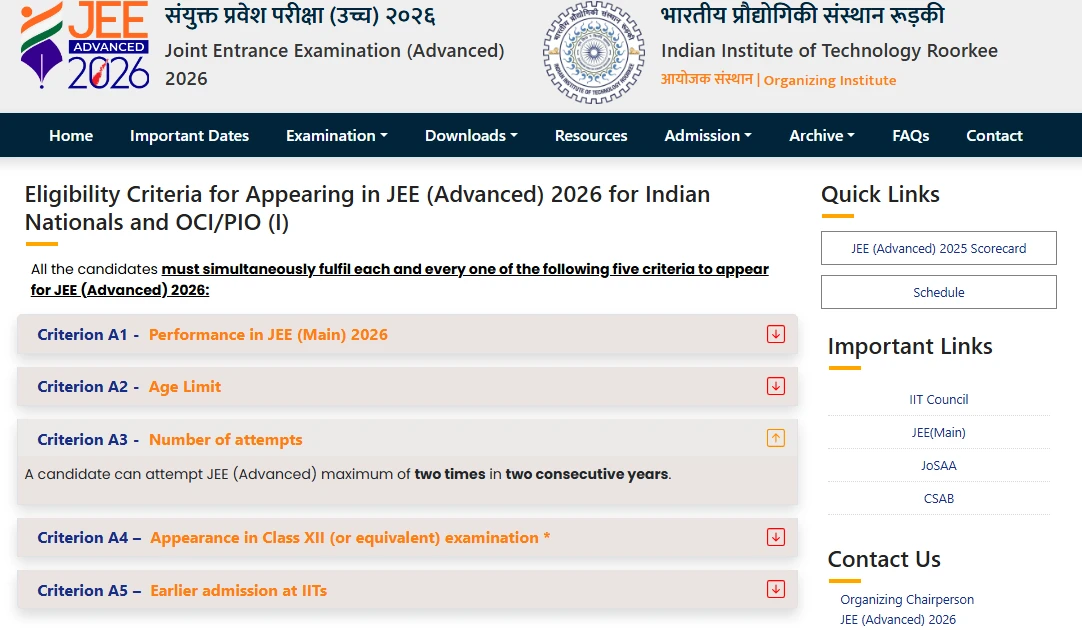
Official JEE Advanced Eligibility Criteria: Only Two Attempts Allowed
The decision, announced by IIT Roorkee, the organising institute for JEE Advanced 2026, reaffirms a long-standing eligibility norm that allows candidates to attempt the JEE Advanced exam only twice, and only in two consecutive years.
While this rule has often sparked debate among students and parents, IITs believe it plays a crucial role in maintaining both academic balance and student well-being.
JEE Advanced 2026 Two Attempts: What Exactly Is the Rule?
As per the JEE Advanced 2026 eligibility criteria:
- A candidate can attempt JEE Advanced only twice
- These attempts must be in two consecutive years
- Candidates must have appeared for Class 12 (or equivalent) for the first time in 2025 or 2026
- Physics, Chemistry, and Mathematics remain mandatory subjects
Importantly, no changes have been made to the eligibility rules compared to last year.
Why are Attempts for JEE Advanced 2026 Capped?
According to IIT officials and education experts, the two-attempt limit is not arbitrary. It’s backed by years of observation and research.
Here’s the reasoning behind it:
1. Prevents Student Burnout
Long-term preparation spanning three, four, or even five years often leads to extreme academic pressure. Studies within the IIT system have shown that students qualifying in later attempts do not necessarily perform better once admitted. Extended preparation, in many cases, adds anxiety rather than improving outcomes.
2. Maintains Age Parity in Classrooms
Allowing unlimited attempts creates a wide age gap among students in the same batch. This affects teamwork, peer learning, mentorship structures, and even hostel life. A more uniform age group ensures a healthier academic and social environment on campus.
3. Reduces Coaching-Driven Saturation
Multiple attempts often push students into prolonged coaching cycles. The two-attempt rule discourages this trend and brings focus back to conceptual clarity and timely preparation, rather than endless repetition.
4. Aligns with Global Academic Practices
Globally, undergraduate engineering programs expect students to enter soon after school. And not after years of exam-focused preparation. IITs aim to stay aligned with this academic philosophy.
What About Students from Weaker Backgrounds?
This is where the conversation often gets more nuanced.
Experts agree that the real equity challenge is not the number of attempts, but access to quality preparation.
IIT leaders have underlined that true equity will come not from increasing attempts, but from strengthening the preparation ecosystem itself. This includes better school-level education, wider access to high-quality digital learning, strong IIT-led mentorship networks for rural and EWS students, and the use of AI-driven personalised learning tools to support learners with limited resources.
The idea is simple: even a single attempt should feel powerful and fair, if the preparation ecosystem is strong.
No Plans to Increase Attempts for JEE Advanced 2026
The two-attempt limit is a long-standing policy. There are no current plans to increase the number of attempts. A similar relaxation announced last year was withdrawn quickly after concerns were raised, reinforcing the IITs’ firm stance on this issue
The Bigger Takeaway for Aspirants
For students preparing for JEE Advanced 2026, the message is clear:
Quality of preparation matters more than the number of attempts.
Because when preparation is focused and well-structured, two attempts are more than enough.
Source
Official Announcement on JEE Advanced website, click here to visit.
Kindly note that any and all information is subject to change as per IIT Roorkee, Education Ministry, and Government of India.
Important Links
| IIT Announces Official JEE (Advanced) 2026 Exam Date | JEE Advanced 2025 Paper Analysis: Difficulty & Insights |