

The Maharashtra State Board of Secondary and Higher Secondary Education (MSBSHSE) has provided valuable insights from experts to help students prepare effectively for the HSC Board Exams 2025. Here’s a detailed guide covering essential preparation tips, time management strategies, subject-wise insights, and exam day protocols.
Preparation Strategies and Resources
- Cover the entire syllabus thoroughly.
- Practise extra questions to enhance understanding and application.
- Utilise textbooks, SCERT Prashna Pedhi, and the MSBSHSE mobile app for study material.
Time Management During the Exam
- Discuss with your teacher time allotment for each answer.
- Upon receiving the question paper, read it completely and prioritise questions.
- Allocate 170 minutes to answering and keep the last 10 minutes for rechecking.
- Answer all questions in sequence to avoid confusion.
Exam Day Essentials
- Visit the exam centre in advance to familiarise yourself with the centre location and the area.
- Pack necessary items the night before: hall ticket, ID card, black and blue pens, scale, writing pad, sharpened pencils, transparent pouch, etc.
- Arrive at the centre at least 30 minutes before the exam time.
- Check your seat number upon arrival.
Answer Sheet Guidelines
- Hall ticket and ID are necessary for verification in the exam hall.
- Check for sequence-wise numbering and binding of the answer sheet. If tampered, request a new one.
- Ensure all details like seat number (in words and numerals), subject, medium of language, and supervisor’s signature are correct.
- Verify the bar code for the subject code and your details to ensure accuracy.
- Stick the holograph in the last 10 minutes and mention the number of supplements used.
- Use the last page (left side) for rough work with a pencil.
Dos and Don’ts
Do’s:
- Follow instructions carefully.
- Keep all required materials ready.
- Maintain focus and discipline.
- Use proper formatting in answers.
Don'ts:
- Do not carry a smartwatch, phone, calculator, or any written material.
- Avoid talking to others during the exam.
- Do not tear any pages from the answer sheet.
- In the exam hall, avoid picking up any unfamiliar or dropped objects that are close to you.
Subject-Wise Guidance
English
- Read textbooks thoroughly.
- Refer to previous years’ question papers.
- Use the ‘Read-Comprehend-Write’ pattern when attempting the exam.
- Focus on summary and mind mapping.
- Practise writing using extract passages.
Marathi
- The Marathi Paper weighing 80 marks is divided into 5 sections: Gadya (Prose), Padya (Poetry), Katha Sahityaprakar Parichay (Story), Upyojit Marathi (Applied Marathi), and Vyakaran ani Lekhan (Grammar and Writing).
- It tests students’ knowledge, understanding, application, opinions, creative writing techniques, and literary terms.
Hindi
- In the Hindi paper a minimum of 42 marks can be easily obtained.
- Focus on Padya (poetry) and Gadya (prose) passages.
- Shuddhlekhan, Kaal Parivartan (Tense), and Vikalp topics account for 8 marks in the paper.
- Grammar sections include Rasa, Alankar, Muhavare, Ling, and Sahayak Kriyapad.
- Pay closer attention to sentence transformation and linguistic rules.
Physics
- You can score at least 70 out of 98 marks (28 marks are optional).
- Knowledge-based questions are about 30% of the paper, in which definitions, laws, and properties are asked.
- There are 42% understanding-based questions, which include explanations and derivations.
- Skill-based questions are 28%, which include diagrams, numericals, and experiments.
- Diagrams should be drawn with a pencil and labelled correctly.
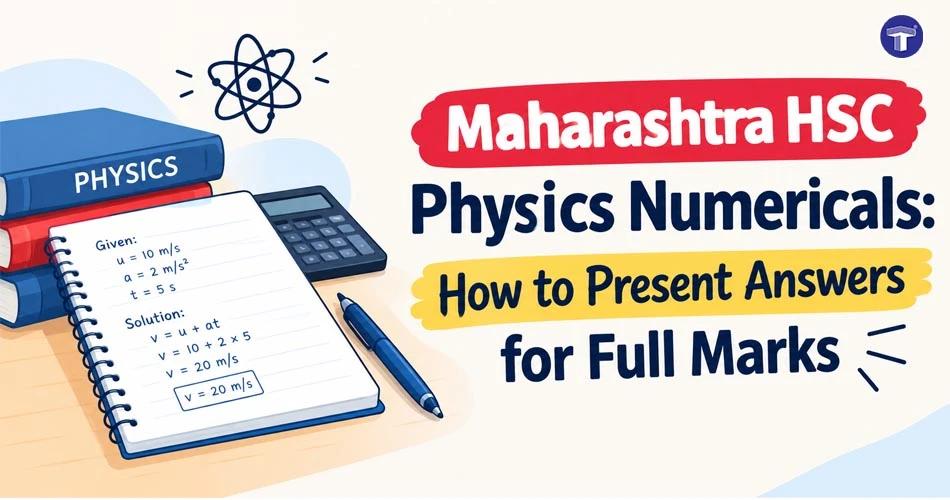
- Solve numerical problems systematically (Given data → Formula → Substitution → Results→ Answer with unit).
- Magnetism and Semiconductor Electronics: Materials, Devices and Simple Circuits are some of the easy topics to focus on.
- Study all the definitions, laws, differentiation, properties, and diagrams from each topic.
Chemistry
- Section-wise time allocation: Section A (1 min per mark), Section B (2 min per mark), Section C (3 min per mark), Section D (4 min per mark).
- Use the last 10 minutes of the exam for rechecking.
- Focus on IUPAC nomenclature, Electronic Configurations: p block, d block, f block, Reaction Mechanisms, and Laws.
- Graphs are crucial for Chemical Kinetics.
- In the Reaction mechanism topic, Electrophilic attack, Nucleophilic attack, Positive charge, Negative charge, and Compensation are important.
- Important reactions include Stephen Reaction, Mendius Reaction, and Clemmensen Reduction Reaction.
- Study Reaction Conditions and Catalysts.
- Revise important rules like Markovnikov's rule and Saytzeff's rule.
- In Solid State, study Crystal Defects and Crystal System.
Mathematics
- Around 20% of the paper consists of easy questions.
- Memorise formulas for Trigonometry, Integration, and Derivatives. Formula-based questions account for 10-15 marks.
- Theorems are crucial in both Paper 1 and 2.
- Paper 1 might consist of 2 questions from topics like Vector, Trignometric Function, and Pair of Lines.
- Paper 2 might consist of 1 question from topics like Derivatives, Integration, and Definite Integration Properties.
- The first 5 minutes of the exam can be utilised for selecting questions.
- Section A is compulsory. In section B, out of 12 questions, 8 need to be solved. In section C, out of 12 questions, 8 need to be solved.(3 marks each) In section D, there are 2-3 theorems accounting for 4 marks.
- Some of the easiest topics with their marks are Logic (8 marks), Matrices (6 marks), and Linear Programming (4 marks).
Biology
- Answer objective-type questions concisely.
- Draw diagrams only when required.
- Distinguish between points clearly.
- Write long answers point-wise and include diagrams.
Organization of Commerce and Management
- It is a theoretical subject in which textbook and syllabus is important.
- Determine the length of an answer by analysing the distribution of marks.
- In Question 1 (multiple choice question), rewrite the sentence only if mentioned.
- Question 4 consists of distinguish between which can fetch full marks.
- Examine case studies thoroughly for each subject. Write the answer in a single word or sentence. Write two sentences if the question is opinion-based.
- For long answer questions, topics like Business Services and Marketing Topics are important. There are three types of long answer questions. One question worth eight marks is asked in the first format. In the second format, the question can be divided into two halves, with two marks going to the definition and six points going to the other question. There are three questions in the third format. The third question will have a mark distribution of 2-3-3.
Economics
- The Economics paper is 50% easy and 50% moderate in difficulty.
- Question 1, Question 2, and Question 5 (totaling to 40 marks) can be solved first for maximum marks.
- Question 3 and Question 6 can be solved afterwards as they are long answer questions.
- Draw figures and tables neatly with a pencil.
- Important topics like 3A, 3B, 4, 6, 7, 8, 9 have a 12 marks weightage. Around 70%-80% of the paper is based on these topics.
Bookkeeping and Accountancy
- To study Bookkeeping and Accountancy, you need to carefully analyse the paper pattern and weightage of each topic.
- In the paper pattern, there are 20 marks for objectives and 60 marks for problem-solving.
- The important objectives in this subject are True or False (every sentence 2.5 marks), Bill of Exchange (5 marks), and other objectives (8 marks).
- Final Accounts accounts for 4 marks.
- Admissions, Retirement, and Dissolution are for 2 marks each. Issue of Shares, Death of Partner, Analysis of Financial Statement, and Computer Account are for 1 mark.
- Consistent practice is essential.
History
- Study history as a story for better retention.
- Question 1, Question 2, and Question 3 account for 31 marks.
- The remaining 49 marks can be scored from long-answer questions.
By following these expert recommendations, you can maximise your efficiency and improve performance in the HSC Board Exams 2025. Consistent practice, proper time management, and staying calm during the exam will lead to success. Best of luck!
Source
Guidance from experts on how to prepare for HSC exam, how to write answer sheets, and how to create a stress-free environment during exams, Maharashtra State Board of Secondary and Higher Secondary Education, 23 January, 2025, https://www.youtube.com/watch?v=3qx4r_on7To
Kindly note that all and any exam-related information might be subject to change as per the Maharashtra State Board of Secondary and Higher Secondary Education.
Also read
Maharashtra Board Shares Guidance from Experts for SSC Board Exams 2025
Maharashtra Board Launches the MSBSHSE App for SSC & HSC
Hall Tickets for Maharashtra 2025 SSC Board Exams Released
Maharashtra Education State Board Implements 'Copy-Mukt Abhiyaan' for SSC and HSC Students
Maharashtra State Board: New Measures for SSC, HSC Board Exams