
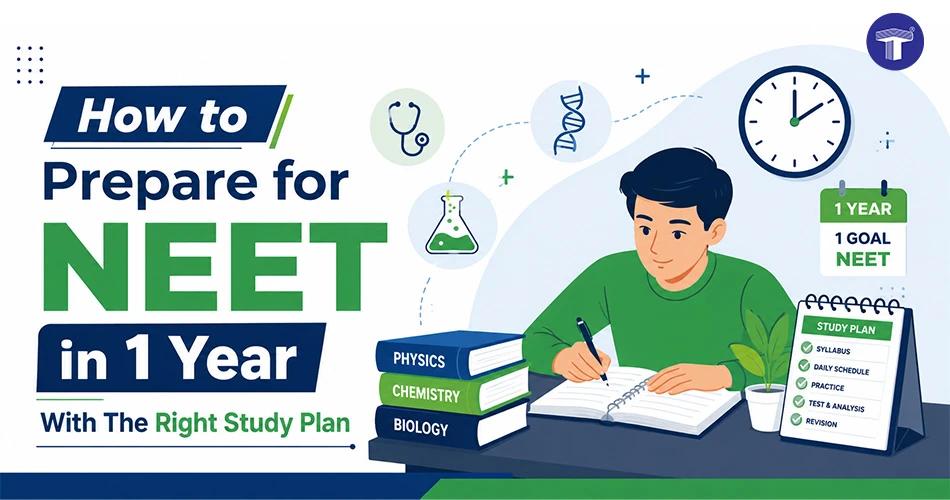
If you’re searching for how to prepare for NEET in 1 year, the answer depends on how honestly you follow the syllabus, timetable, revision plan, and test practice.
One year is a good time for NEET preparation if it is used properly. You’re not supposed to study randomly for long hours.
The right NEET preparation strategy should include NCERT reading, concept building, MCQ practice, previous years’ questions, mock tests, regular revision, and so on. Let’s know about a simple one-year plan that you can follow with discipline for cracking NEET.
Is 1 Year Enough for NEET Preparation?
Yes, one year can be enough for NEET preparation if you start seriously and follow a structured routine.
NEET tests concepts from Physics, Chemistry, and Biology. You have to cover Class 11 and Class 12 topics, so the preparation plan must balance both years properly.
You can start from the basic level and do not panic. Put your first few months focusing on understanding concepts. The next few months should focus on MCQs and revision. The last phase should focus on mock tests and mistake correction.
This is how you can properly create a 1 year study plan for NEET.
How to Crack NEET in 1 Year From Zero Level
If you’re searching for how to crack NEET in 1 year from zero level, you’re not the only one. The right way is to start from the basics. For example, you can check out the NEET Absolute series to make your basics strong. You should not directly jump to advanced books or full syllabus tests.
The first goal should be to understand NCERT topics and build confidence.
Here is a simple starting method:
| Preparation Area | What to Do First |
| Physics | Learn basic concepts, formulas, and solved examples |
| Chemistry | Start with the NCERT theory and basic numerical practice |
| Biology | Read NCERT line by line and revise diagrams |
| MCQs | Solve easy chapter-wise questions first |
| Revision | Make short notes from the first month |
| Tests | Start with chapter tests before full mock tests |
NEET Preparation Roadmap for 1 Year
A good NEET preparation roadmap should have three main phases.
| Phase | Months | Main Focus |
| Phase 1 | Month 1 to Month 4 | NCERT reading and concept building |
| Phase 2 | Month 5 to Month 8 | MCQ practice, PYQs, and chapter tests |
| Phase 3 | Month 9 to Month 12 | Revision, mock tests, and error correction |
You can also read NEET 2026 preparation roadmap guide to understand in-depth about how each phase makes your journey of cracking NEET (UG) a step closer.
Daily Study Timetable for NEET
A daily study timetable for NEET should be realistic. You should not make a timetable that looks good on paper but becomes impossible to follow.
Here is a sample routine for self-study students searching for an NEET study schedule to create a NEET study plan for 1 year:
| Time Slot | Study Task |
| Morning | Biology NCERT reading and revision |
| Late Morning | Physics concept and numerical practice |
| Afternoon | Chemistry theory and MCQs |
| Evening | Chapter-wise MCQs or PYQs |
| Night | Revision of formulas, diagrams, and mistakes |
You can also use the best app for NEET (UG) preparation: Tayari App for tailored NEET preparation. It covers every essential part of NEET preparation, from PYQs, MCQs, AI-based training, mock tests, and a lot more.
How Many Hours Should You Study Daily?
Students often ask how many hours are needed to crack NEET. However, there is no fixed number for every student.
For serious one-year preparation, you may need around 6 to 8 focused study hours daily apart from school or coaching. If you do self-study, you may need more time because you have to manage concept learning, practice, and revision on your own.
How to Divide Time Among Physics, Chemistry, and Biology
A good NEET preparation schedule should give enough time to all three subjects. Biology has more questions, but Physics and Chemistry cannot be ignored.
Here is a simple time division:
| Subject | Daily Focus |
| Biology | NCERT reading, diagrams, and MCQs |
| Chemistry | Theory, reactions, formulas, and MCQs |
| Physics | Concepts, formulas, and numericals |
You can follow this daily split:
- Biology: 2 to 3 hours
- Chemistry: 2 hours
- Physics: 2 to 3 hours
- Revision and MCQs: 1 to 2 hours
Best Strategy to Crack NEET in 1 Year
The best strategy to crack NEET is to keep the plan simple and repeat it consistently.
You should follow this cycle for every chapter:
- Read the theory.
- Understand key concepts.
- Make short notes.
- Solve basic MCQs.
- Solve NEET-level MCQs.
- Practise NEET previous year questions.
- Revise wrong answers.
- Take a chapter test.
Subject-Wise NEET Exam Preparation Strategy
A strong NEET exam preparation strategy should be different for each subject.
Physics Strategy
Physics needs patience. You should first understand concepts and then solve numerical questions. Also, ensure you’re using the right NEET Physics books.
Focus on:
- Formula clarity
- Basic derivations
- Unit and dimension understanding
- Daily numerical practice
- Previous years’ questions
- Time-bound solving
Chemistry Strategy
Chemistry should be divided into Physical, Organic, and Inorganic Chemistry.
Focus on:
- NCERT theory for Inorganic Chemistry
- Reaction practice for Organic Chemistry
- Formula-based numericals for Physical Chemistry
- Short notes for reactions and exceptions
- Regular MCQ practice
Biology Strategy
Biology should be studied mostly from the NCERT first. You should read every chapter carefully.
Focus on:
- NCERT lines
- Diagrams and labels
- Tables and examples
- Statement-based questions
- Assertion-reason practice
- Repeated revision
When to Start NEET Mock Tests
You should not wait until the final month to begin mock tests.
Start chapter tests from the first few months. Then, carry on with part of the syllabus tests once a few chapters are complete. Thus, start full-length NEET mock tests after covering most of the syllabus.
A good plan can be: Dedicate Month 1st to 4th for Chapter tests. Then, cover Part syllabus tests and PYQs in the 5th to 8th months. Lastly, focus on full-length NEET mock tests from the 9th to 12th months.
Best Resources for NEET Preparation in 1 Year
You need resources as the foundation to your plan of how to crack NEET in 1 year without coaching.
A balanced resource list can include:
| Resource | Purpose |
| NCERT Books | Concept base and theory clarity |
| Subject-wise NEET Books | Chapter-wise practice |
| NEET PYQ Books | Understanding exam trends |
| NEET Mock Test Papers | Speed and accuracy practice |
| Short Notes | Final revision |
| Error Notebook | Mistake correction |
Target Publications offers NEET preparation books, PYQ resources, and mock test papers for Physics, Chemistry, and Biology. You can use these resources along with the NCERT to plan, practice, and revise in a structured way.
Final Thoughts
Preparing for how to crack NEET in first attempt in 1 year is possible when you follow a clear plan and stay consistent.
A smart plan does not mean studying all day without direction. It means studying the right topics and solving the right questions while correcting mistakes before the final exam.
FAQs
Is one year enough to crack NEET with a good score?
Yes, one year can be enough if you follow a disciplined study plan. The student should complete the syllabus on time, revise NCERT, solve MCQs, practise PYQs, and take regular mock tests.
What are the biggest mistakes students make during one-year NEET preparation?
The biggest mistakes include ignoring NCERT, avoiding weak subjects, studying without a timetable, solving questions without analysis, skipping PYQs, and starting mock tests too late. You should also avoid changing books again and again.
How many hours should I study daily for NEET self-study?
A serious self-study student can aim for around 6 to 8 focused hours daily. Some students may need more time depending on their preparation level. Consistency and quality of study matter more than counting hours.
How should I divide my daily study time among Physics, Chemistry, and Biology?
You can divide time based on their strengths and weaknesses. A balanced plan can include 2 to 3 hours for Biology, 2 hours for Chemistry, and 2 to 3 hours for Physics, along with revision and MCQ practice.
By when should I complete the NEET syllabus in a one-year preparation plan?
You should try to complete the syllabus by the eighth or ninth month. This leaves enough time for revision, mock tests, previous years’ questions, and error correction before the final exam.
When should I start taking full-length NEET mock tests?
You can start full-length mock tests after completing most of the syllabus. Chapter tests should begin in the early months. Full mock tests can become regular from the ninth month onward.
How many mock tests should I attempt before the NEET exam?
There is no fixed number for every student. Students should attempt enough mock tests to improve speed, accuracy, and confidence. In the final months, one to two full-length tests every week can be useful if followed by proper analysis.