
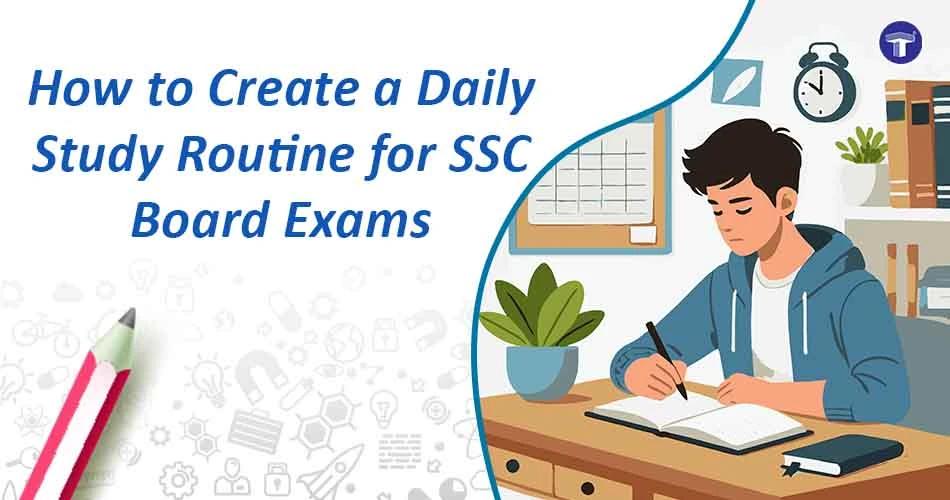
A daily study routine can make SSC Board preparation more manageable. Instead of deciding what to study every evening, you already know which subject needs attention, when to revise and where practice fits into the week.
This blog will help you create a realistic SSC daily study timetable that includes concept learning, written practice, revision and self-testing. Before creating your daily routine, you can also read Maharashtra Board 10th SSC syllabus guide to understand the full Std. 10 subject structure.
Start with Your Actual Daily Schedule
Before making a timetable, write down the time already occupied by school, travel, meals, tuition and sleep. The remaining hours are your realistic study time.
Do not copy someone else’s schedule without checking whether it fits your day. The best study schedule for Class 10 students is the one you create according to your convenience.
Also, identify when you concentrate best. Try studying at different times for one week and notice when you understand difficult concepts faster and make fewer mistakes.
Reserve that period for Mathematics, Science or another challenging subject. If you are unsure about daily study hours, read how many hours a day a Std. 10 SSC student should study.
Set Four Daily Study Priorities
A balanced SSC Board exam study routine should include learning new concepts, practising questions, revising older topics and checking mistakes.
Your weekly routine should cover all four. Reading new chapters without revising older ones can make earlier work fade. For a larger yearly approach, 12-month SSC Board study strategy can help you connect daily routine with long-term preparation.
Sample Daily Study Timetable for Std. 10
| Time | Study Task |
| After returning home | Eat, rest and freshen up |
| First 45-minute session | Mathematics or Science |
| 10-minute break | Move around and avoid screens |
| Second 40-minute session | Language or Social Science |
| Dinner or longer break | Rest |
| Third 30-minute session | Homework or answer-writing |
| Final 20-minute session | Formulae, definitions or mistakes |
To make your routine exam-focused, read Maharashtra Std. 10 SSC exam pattern guide.
Divide Subjects Across the Week
Trying to study every subject deeply every day can make your Class 10 study routine crowded. Keep Mathematics in your schedule regularly because it needs continuous practice. Study Science several times a week through concepts, numericals, equations and diagrams.
Give languages fixed time for grammar, comprehension and writing formats. History, Political Science and Geography need repeated revision, maps, definitions and structured answers.
Social Science answers become easier to revise when you organise events, causes, outcomes and key political concepts under clear headings. Std. 10 History and Political Science Perfect 2.0 Notes can support this approach while practising structured answers.
Keep Weekday and Weekend Routines Different
Your weekday study routine for Class 10 should focus on school lessons, homework and short revision. Use weekends for cumulative revision, difficult chapters and self-assessment.
Take one chapter test or solve selected Board questions, then check mistakes. Keep enough time for rest so the routine remains sustainable.
Study in Short, Focused Sessions
If your attention drops after 35–45 minutes, divide study into shorter sessions with planned breaks.
Set one clear task for each session, such as solving ten Algebra questions, revising one Science concept or practising one writing format. Avoid vague targets such as “study Maths.”
During breaks, stand up, drink water or walk briefly instead of opening social media. To plan subject-wise preparation better, read how to study for the 10th SSC Board exam.
Build Revision into the Routine
If you’re considering creating the best study routine for Class 10, do not postpone revision until prelims. Spend a few minutes daily recalling what you studied and keep one weekly slot for older chapters.
Revise a topic the next day, again at the end of the week and once more after a few weeks. First try to recall formulae, points, diagrams or steps without looking at the textbook.
You can then use All Subject Exam Experts Boards Solved Papers to practise board-style questions from revised chapters and check whether you can apply what you have learned correctly.
Include Written Practice and Tests
SSC Board preparation requires you to present answers clearly within a limited time. Once enough syllabus is complete, add timed chapter tests and previous years’ questions. Begin full paper practice after completing one syllabus round and basic revision. Once one syllabus round is complete, students can practise with Std. 10 English Medium All Subjects Board Solved Papers.
Common Timetable Mistakes to Avoid
Do not create a schedule that removes sleep or fills every minute of the day. Avoid keeping all difficult subjects for one evening or leaving all revision for Sunday.
If you miss one session, resume at the next planned slot. You can also explore the SSC Board Papers download section when you are ready for previous-year paper practice.
Important Links
| Common Mistakes Committed by Std. 10 SSC Board Students | How to Score 90+ in Std. 10 SSC Board Examinations? |
Conclusion
The best study time table for Class 10 is realistic, balanced and flexible. Build it around your school schedule, use productive hours for difficult subjects and include daily practice, weekly revision and regular testing.
You do not need a perfect study routine for Class 10 students every day. You need a system that keeps your SSC Board preparation moving forward.
FAQs
1. Is it necessary to follow the same study timetable every day?
Ans: No. Keep a basic structure, but adjust subjects and session lengths according to schoolwork, tests and energy levels. Consistency matters more than identical timings.
2. How can students identify the most productive hours for studying?
Ans: Test different study periods for a week. Notice when you understand difficult topics faster, stay focused longer and make fewer mistakes.
3. Can students prepare effectively for SSC Board exams without attending coaching classes?
Ans: Yes. School learning, prescribed textbooks, regular self-study, written practice and timely doubt-solving can support effective preparation.
4. Should students prepare separate daily routines for weekdays and weekends?
Ans: Yes. Keep weekdays focused on current lessons and homework. Use weekends for revision, tests, weak chapters and pending work.
5. Is studying in multiple short sessions better than one long study session?
Ans: It can be, especially when concentration falls during long sessions. Use focused sessions with clear targets and short breaks