
If you’re preparing for the Maharashtra SSC Board Exam 2027, the first thing you need is a clear understanding of the Maharashtra SSC syllabus. Once you know the subjects and chapters while understanding the exam structure, your preparation becomes more organised.
This blog gives you a subject-wise overview of the Maharashtra board 10th syllabus based on the latest available Maharashtra State Board Std. 10 textbook.
SSC Board Maharashtra Exams and Their Importance
The Maharashtra SSC exam is conducted for Std. 10 students across the state. It marks the completion of secondary school education and helps you move towards higher secondary education.
Your SSC marks can also influence your stream selection after. That is why you should understand the Maharashtra state Board 10th syllabus before making your study timetable.
SSC Board Maharashtra Exam Structure: Overview
Before checking the subject-wise syllabus, you should understand the basic exam structure.
| Particular | Details |
| Class | Std. 10 |
| Board | Maharashtra State Board |
| Main Areas | Languages, Mathematics, Science, and Social Science |
| Exam Mode | Offline written exam |
| Assessment | Theory paper and internal or practical work, wherever applicable |
| Question Type | Objective, short answer, long answer, and application-based questions |
| Negative Marking | Usually not applicable |
Passing Criteria for SSC Board Maharashtra Exams
To pass the SSC Board exam, you need to score the required minimum marks in each subject as per Maharashtra Board rules. However, your aim should not be only to pass. A good SSC score can help you during junior college admission and stream selection.
You must use the right 10th standard books to revise chapters and solve questions while knowing the board-style answers.
Maharashtra 10th SSC Board Syllabus
The core subjects in the SSC Board syllabus for Maharashtra usually include
- English
- Marathi
- Hindi
- Mathematics
- Science
- Social Science
Let us look at the Maharashtra board 10th syllabus, subject-wise, now.
10th Std Maharashtra Board English Syllabus
The English Kumarbharati syllabus includes prose, poetry, grammar, communication skills and writing practice.
Unit One
1.1 Where the Mind is Without Fear...
1.2 The Thief’s Story
1.3 On Wings of Courage
1.4 All the World’s a Stage
1.5 Joan of Arc
1.6 The Alchemy of Nature
Unit Two
2.1 Animals
2.2 Three Questions
2.3 Connecting the Dots
2.4 The Pulley
2.5 Let’s March
2.6 Science and Spirituality
Unit Three
3.1 Night of the Scorpion
3.2 The Night I Met Einstein
3.3 Stephen Hawking
3.4 The Will to Win
3.5 Unbeatable Super Mom-Mary Kom
3.6 The Concert
Unit Four
4.1 A Thing of Beauty is a Joy For Ever
4.2 The Luncheon
4.3 World Heritage
4.4 The Height of the Ridiculous
4.5 The Old Man and The Sea: Book Review
4.6 The Gift of the Magi
For English, practise grammar, comprehension, writing skills and textbook-based answers regularly.
10th Std Maharashtra Board Hindi Syllabus
The Hindi syllabus usually includes गद्य, पद्य, पूरक पठन, व्याकरण, भावार्थ and writing skills.
Some commonly studied Hindi Lokbharati chapters and sections include
- भारत महिमा
- लक्ष्मी
- वाह रे! हमदर्द
- गोवा: जैसा मैंने देखा
- गिरिधर नागर
- रीढ़ की हड्डी
- कृषक का गान
- बरषहिं जलद
- श्रम साधना
- छापा
- महिला आश्रम
- अपनी गंध नहीं बेचूँगा
- समता की ओर
Note: Hindi textbook selection may vary depending on first language, second language, third language, medium and school choice. Confirm your exact Hindi textbook with your school.
10th Std Maharashtra Board Marathi Syllabus
The Marathi syllabus includes गद्य, पद्य, स्थूलवाचन, व्याकरण and उपयोजित लेखन.
Unit One
- तू बुद्धी दे
- संतवाणी
- शाल
- उपास
- मोठे होत असलेल्या मुलांनो...
Unit Two
- दोन दिवस
- चुडीवाला
- फूटप्रिन्टस
- ऊर्जाशक्तीचा जागर
- जाता अस्ताला
Unit Three
- औक्षण
- रंग साहित्याचे
- जंगल डायरी
- रंग मजेचे रंग उदयाचे
- जगणं कॅक्टसचं
Unit Four
- हिरवंगार झाडासारखं
- बीज पेरले गेले
- खरा नागरिक
- स्वप्न करू साकार
- व्युत्पत्ती कोश
- उपयोजित लेखन
For Marathi, revise
- Poems
- Meanings
- Grammar rules
- Writing formats
Also, write answers in clean and simple language.
10th Std Mathematics Maharashtra Board Syllabus
The Maharashtra state board class 10 maths syllabus is divided into Mathematics Part 1 and Mathematics Part 2.
Mathematics Part 1
- Linear Equations in Two Variables
- Quadratic Equations
- Arithmetic Progression
- Financial Planning
- Probability
- Statistics
Mathematics Part 2
- Similarity
- Pythagoras Theorem
- Circle
- Geometric Constructions
- Co-ordinate Geometry
- Trigonometry
- Mensuration
For Maths, do not only read solved examples. Solve them again on paper. Make a formula notebook and revise it every week. Step-wise presentation is very important in this subject.
10th Std Science Maharashtra Board Syllabus
Science is divided into Science and Technology Part 1 and Part 2.
Science and Technology Part 1
- Gravitation
- Periodic Classification of Elements
- Chemical Reactions and Equations
- Effects of Electric Current
- Heat
- Refraction of Light
- Lenses
- Metallurgy
- Carbon Compounds
- Space Missions
Science and Technology Part 2
- Heredity and Evolution
- Life Processes in Living Organisms Part 1
- Life Processes in Living Organisms Part 2
- Environmental Management
- Towards Green Energy
- Animal Classification
- Introduction to Microbiology
- Cell Biology and Biotechnology
- Social Health
- Disaster Management
For Science, practise
- Diagrams
- Definitions
- Laws
- Equations
- Numericals
- Reasoning-based questions
- Use correct scientific terms in your answers.
10th Std History and Political Science Maharashtra Board Syllabus
History and Political Science help you understand society, governance, heritage and democracy.
History
- Historiography: Development in the West
- Historiography: Indian Tradition
- Applied History
- History of Indian Arts
- Mass Media and History
- Entertainment and History
- Sports and History
- Tourism and History
- Heritage Management
Political Science
- Working of the Constitution
- The Electoral Process
- Political Parties
- Social and Political Movements
- Challenges Faced by Indian Democracy
10th Std Geography Maharashtra Board Syllabus
Geography includes practical geography, physical geography and human geography.
- Field Visit
- Location and Extent
- Physiography and Drainage
- Climate
- Natural Vegetation and Wildlife
- Population
- Human Settlements
- Economy and Occupations
- Tourism, Transport and Communication
Maharashtra Board SSC Study Plan
Once you know the Maharashtra board class 10 chapter list, prepare a simple study plan.
| Stage | What You Should Do |
| Stage 1 | Read every textbook chapter carefully |
| Stage 2 | Complete textbook exercises and notebook work |
| Stage 3 | Revise difficult chapters and important topics |
| Stage 4 | Solve previous year papers and practice papers |
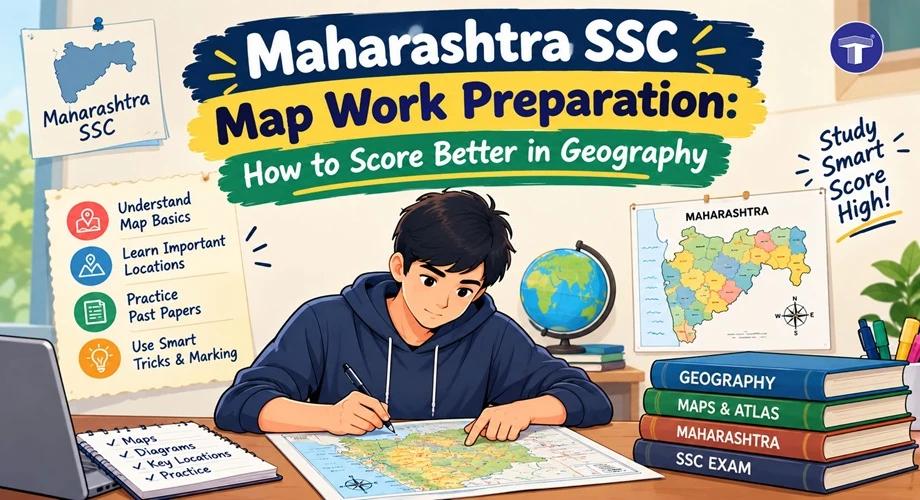
| Stage 5 | Revise formulas, grammar, maps and diagrams |
FAQs
1. How often does the Maharashtra Board update the SSC syllabus?
Ans: The Maharashtra Board may update the SSC syllabus whenever academic changes are introduced. Such updates are usually shared through official channels or schools. You should confirm the latest syllabus with your school before starting final board exam preparation.
2. How can students verify that they are studying the latest syllabus?
Ans: You can verify the latest syllabus through your school, prescribed textbooks and official Board-related sources.
3. Is the Maharashtra SSC syllabus different for English-medium and Marathi-medium students?
Ans: The core subject structure is mostly similar, but textbooks may differ for English-medium and Marathi-medium students. English and Marathi subjects can vary based on first language and second language selection.
4. Which subject in the Maharashtra SSC syllabus requires the most preparation time?
Ans: It depends on your strengths and weak areas. Many students need more time for Mathematics and Science because these subjects need regular practice. Some students may need more time for languages or Social Science if writing speed and memorisation are challenging.
5. How should students prioritise subjects based on the syllabus?
Ans: Divide subjects into strong, moderate and weak areas. Give extra time to weak subjects, but revise strong subjects regularly. Prioritise chapters with formulas, diagrams, grammar rules, maps and long answers. Keep your plan balanced so that no subject is ignored.
6. Which syllabus topics are commonly considered challenging by students?
Ans: Students often find Algebra, Geometry, Science numericals, diagrams, grammar, map work, and long Social Science chapters challenging. These topics become easier when you break them into smaller parts and revise them regularly.