
CBSE has announced an important update in how Class 12 Board exam answer sheets will be evaluated.
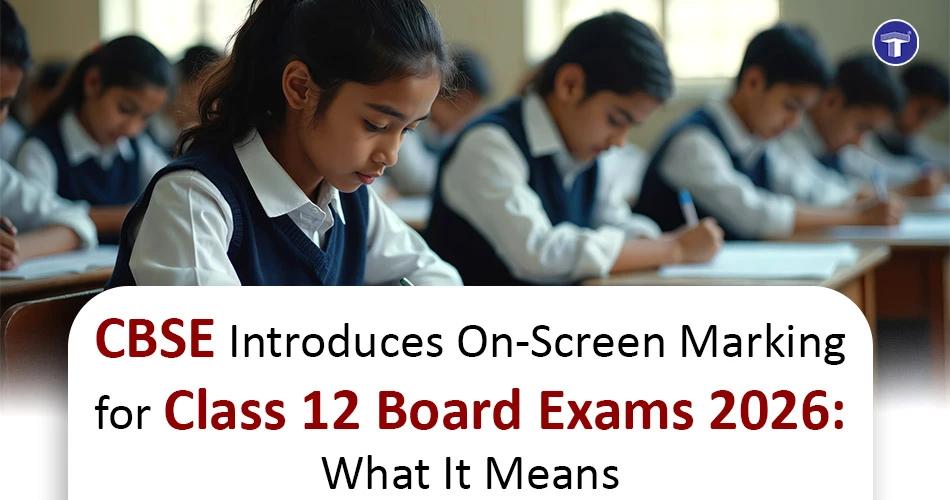
The Board confirmed that it will implement On-Screen Marking (OSM) for the evaluation of CBSE Class 12 answer books.
This marks a shift from the long-standing physical checking system to a digital evaluation process. While the change is administrative in nature, it could influence how quickly and efficiently results are processed.
Here is a simple breakdown of what this update involves.
What is On-Screen Marking for CBSE Class 12 Exams 2026?
On-Screen Marking is a digital evaluation system. Instead of sending physical answer books to examiners, CBSE will scan the answer sheets. Evaluators will then assess these scanned copies on a secure digital platform.
Teachers will mark answers directly on a computer screen. The system automatically records marks and totals, reducing the need for manual calculations.
For now, On-screen marking system applies only to CBSE Class 12 2026 Board exams. CBSE Class 10 evaluation will continue using the traditional physical method for 2026.
Why is CBSE Moving to a Digital Evaluation System?
The circular outlines several reasons behind the shift. At its core, the move is aimed at improving efficiency and consistency in evaluation.
A digital system can help minimise common issues such as totaling errors or misplacement of answer scripts. It can also streamline logistics, since physical transport of answer books is no longer required at the same scale.
Another practical benefit is flexibility for evaluators. Teachers may be able to participate in the marking process without travelling long distances to evaluation centres.
That said, like any large-scale change, the success of OSM will depend on how smoothly it is implemented and how comfortable evaluators become with the technology.
What CBSE Schools Need to Prepare for On-screen Marking System
To support On-Screen Marking, CBSE has asked schools to ensure certain infrastructure is in place. This includes functional computer labs, reliable internet connectivity, and updated systems capable of running the evaluation platform. The Board also plans to organise training sessions and orientation programmes for teachers. These are meant to familiarise evaluators with the new system before full-scale implementation.
What This Means for Students
For students, the examination pattern and question papers remain unchanged. The shift is limited to how answer books are evaluated after the exams.
In theory, a digital system could make the evaluation process more streamlined. This may contribute to smoother processing of results. However, students are unlikely to notice any immediate difference in their exam experience.
The main focus remains the same. Students still need to prepare thoroughly and perform well in the written exam.
Source
Official Notice by CBSE, 09 February, 2026: click here to read.
Kindly note that any and all information is subject to change as per CBSE, Education Ministry, and Government of India.
Important Links