
If you are preparing for MHT-CET, understanding its marking scheme can help you make smarter decisions during the exam. Since the standard MHT-CET marking scheme does not penalise incorrect answers, leaving a question unanswered may mean missing a scoring opportunity. However, this does not mean you should guess randomly without considering the time available.
Follow the WhatsApp channel Education News by Target Publications for exam-related updates, and use the Tayari App to practise questions and revise concepts. Regular mock tests can help you develop an effective MHT CET guessing strategy before exam day.
Is There Negative Marking in MHT-CET?
No, the standard MHT-CET examination pattern does not deduct marks for incorrect answers. Correct answers earn marks, while incorrect and unanswered questions do not earn marks. Always check the official information brochure for your examination year to confirm the applicable rules.
The MHT CET no negative marking rules make attempting uncertain questions worthwhile in many situations. Instead of leaving a question blank, you can select the option you consider most likely to be correct. However, avoid spending too much time on a difficult question when easier questions remain unanswered.
Understanding the MHT-CET Marking Scheme
The marking scheme of MHT-CET varies according to the subject and examination group. The standard pattern awards marks for correct responses without deducting marks for incorrect ones. Check the latest official brochure for the exact subject-wise distribution.
Understanding the MHT CET negative marking scheme is important because other entrance examinations may follow different rules. Your MHT CET exam strategy should focus on maximising correct responses while managing time effectively.
How Should You Change Your MHT-CET Guessing Strategy?
Your MHT CET no negative marking strategy should prioritise confident answers, efficient problem-solving and sensible guessing.
1. Solve Questions You Know First
Begin with questions you can answer confidently. Secure these opportunities before spending time on difficult calculations or unfamiliar concepts. If a question takes too long, move ahead and return to it later.
2. Use Option Elimination
The MHT CET option elimination strategy helps you make informed choices. Eliminate options that contradict a formula, concept or known fact. Even if you cannot solve the question completely, removing unlikely answers may improve your chances.
3. Return to Uncertain Questions
Once you have attempted familiar questions, revisit the ones you skipped. Re-read them carefully, identify relevant concepts and use elimination wherever possible. Under the standard no-negative-marking format, an educated guess may be more worthwhile than leaving a question unanswered.
4. Manage Your Time
No negative marking does not mean unlimited time. Your MHT CET question attempt strategy should balance speed and accuracy. Avoid spending several minutes on one difficult question when you could attempt other questions within that time.
MHT-CET Option Elimination: When Should You Guess?
Use these techniques when you cannot immediately identify the correct answer.
- Recall concepts: Use definitions, formulas and principles to eliminate incorrect options.
- Check units and signs: In Physics and Mathematics, incorrect units or signs may reveal an unsuitable answer.
- Estimate results: Approximate numerical answers before comparing the available options.
- Read carefully: Look for exceptions, qualifiers and statements that do not directly answer the question.
- Avoid patterns: Do not assume that one option is more likely to be correct simply because it appeared frequently in previous papers.
Your MHT CET option elimination should rely on the information provided, not unsupported assumptions.
MHT-CET Exam Strategy for Maximum Attempts
An effective MHT CET exam strategy combines preparation, time management and sensible decision-making. Practise timed mock tests to understand how quickly you can solve different question types.
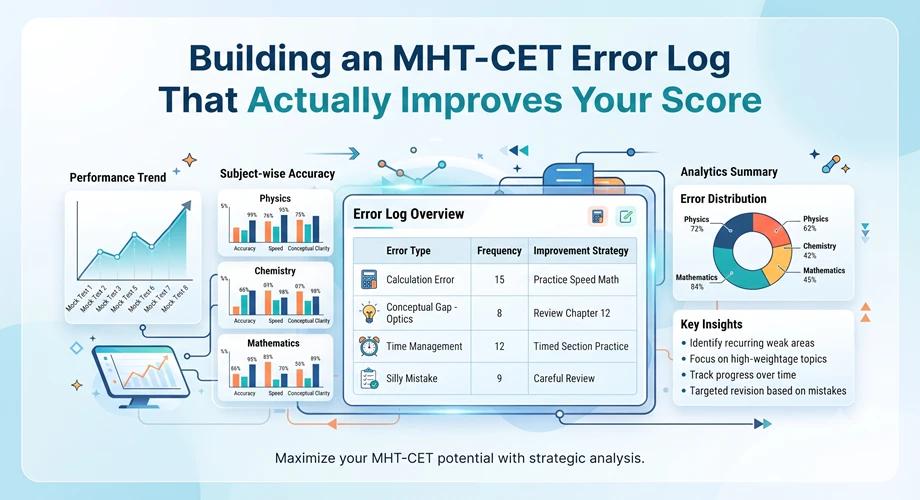
After each test, review incorrect answers, unanswered questions and problems that took too long. Identify whether the cause was weak conceptual understanding, calculation errors or poor time allocation.
Your MHT CET exam strategy for maximum attempts should not involve rushing through every question. Aim to attempt all questions within the available time while maintaining accuracy wherever possible.
What Is the Best MHT-CET Tukka (Guessing) Strategy?
Tukka refers to guessing when you are unsure of the correct answer. A sensible MHT CET tukka strategy involves using whatever information you have before selecting an option.
If you can eliminate one or more choices, make an educated guess from the remaining options. If you have no idea about the answer, avoid wasting valuable time trying to find clues that are not there. Select your best option and move on.
The goal is to distinguish calculated guessing from random selection. Neither guarantees marks, but calculated guessing makes better use of your knowledge.
Important Links:
| December MHT-CET Exam Cancelled: Attempts to Be Held After Std. 12 Board Exam | How to Actually Analyse a Mock Test: A Step-by-Step Error-Categorisation System |
Frequently Asked Questions About MHT-CET Negative Marking
1. Is there negative marking in MHT-CET?
No, the standard marking scheme does not deduct marks for incorrect answers. Check the official brochure for your examination year.
2. Should you attempt every question in MHT-CET?
Aim to attempt every question if time permits. Incorrect answers do not generally attract a penalty, so unanswered questions may represent missed scoring opportunities.
3. Can guessing improve your MHT-CET score?
Yes, a guess can earn marks if correct. Eliminating unlikely options first can help you make more informed choices.
4. What is the best MHT-CET guessing strategy?
Solve familiar questions first, eliminate incorrect options, revisit difficult questions and manage your time carefully.
5. Are unanswered questions penalised in MHT-CET?
Under the standard marking scheme, unanswered questions do not earn marks and do not attract negative marks.
6. Is random guessing better than leaving a question blank?
With no negative marking, a random guess offers a chance of earning marks without reducing your score if incorrect. However, prioritise questions you can solve and use elimination whenever possible.
The MHT CET no negative marking system gives you flexibility, but your performance still depends on preparation, accuracy and time management. Solve familiar questions first, eliminate unlikely options and use educated guesses for the remaining questions. Practise these techniques through mock tests to make your MHT CET guessing strategy more effective on exam day.