


Hey NEET aspirants!
Just 45 days left in hand!
Feeling the pressure of limited time already?
Don’t worry, with the right strategy and dedication, 45 days are ample to prepare effectively for NEET (UG) 2025. With over 15 lakh students appearing for the exam every year, it is crucial to have a well-planned and effective preparation strategy to secure a good rank.
From a well-structured lesson plan to invaluable tips, this blog is here to equip you with the tools you need to prepare for NEET entrance exam.
The Initial 30 Days Plan
In the first 30 day, build up the foundation of your NEET preparation. Before following the timetable, acquaint yourself with the exam paper pattern, syllabus, and weightage of topics. This 30-day planner for Physics, Chemistry and Biology ensures that you allocate adequate time to each subject.
| Days | Physics | Chemistry |
| Day 1 | Physics and measurement | Some Basics Concepts in Chemistry |
| Day 2-3 | Kinematics | Chemical Bonding and Molecular Structure |
| Day 4 | Laws of Motion | Atomic Structure |
| Day 5 | Work, Energy, and Power | Chemical Thermodynamics |
| Day 6 | Rotational Motion | Solutions |
| Day 7 | Gravitation | Equilibrium |
| Day 8-10 | Properties of Solids and Liquids | Redox Reaction and Electrochemistry |
| Day 11 | Thermodynamics | Chemical Kinetics |
| Day 12 | Kinetic Theory of Gases | Classifications of Elements and Periodicity in Properties |
| Day 13-14 | Oscillations and Waves | P-Block Elements |
| Day 15-16 | Electrostatics | Organic Compounds Containing Oxygen |
| Day 17-18 | Current Electricity | Purification and Characterisation of Organic Compounds |
| Day 19-20 | Magnetic Effects of Current and Magnetism | Some Basic Principles of Organic Chemistry |
| Day 21-22 | Electromagnetic and Induction and Alternating Currents | Organic Compounds Containing Halogens |
| Day 23 | Electromagnetic Waves | D-and F- Block Elements |
| Day 24-25 | Optics | Hydrocarbons |
| Day 26 | Dual Nature of Matter and Radiation | Co-ordination Compounds |
| Day 27-28 | Atoms and Nuclei | Organic Compounds Containing Nitrogen |
| Day 29-30 | Electronic Devices | Biomolecules |
| Days | Biology |
| Day 1 | Diversity in Living World |
| Day 2–5 | Structural Organisation in Animals and Plants |
| Day 6–7 | Cell Structure and Function |
| Day 8–12 | Plant Physiology |
| Day 13–19 | Human Physiology |
| Day 20–22 | Reproduction |
| Day 23–24 | Genetics and Evolution |
| Day 25–26 | Biology and Human Welfare |
| Day 27 | Biotechnology and Its Applications |
| Day 28–30 | Ecology and Environment |
Plan for Day 31 to 35
Start revising all the chapters thoroughly.
Plan for Day 35 to 40
Practise solving at least 2 to 3 full length mock tests under timed conditions to simulate the actual exam. By this practice, you can analyse your performance over time and identify the areas for improvement.
Our NEET-UG 10 Full Syllabus Mock Tests kit is perfect for this. Not only do you get access to 10 model papers designed just like the NEET exam question paper, but also 10 OMR sheets to give you the real exam experience. As an added bonus, we have also shared a chapter-wise analysis of questions from the past 11 years so you can gain insights into important topics.
But don’t just take our word for it. See what Renuka Anthwal from Biology at Ease says about it in her latest NEET preparation plan video.
Plan for Day 40 to 45
Last, but not least, the final 5 days of preparation. Here, prioritise active recall techniques like self-testing and concept explanation. Revisit crucial formulas and diagrams from all subjects, and maintain a positive mindset through relaxation techniques. This approach ensures you enter the exam well-prepared and ready to showcase your knowledge.
Subject-Specific Tips for NEET 2025 Preparation
Physics:
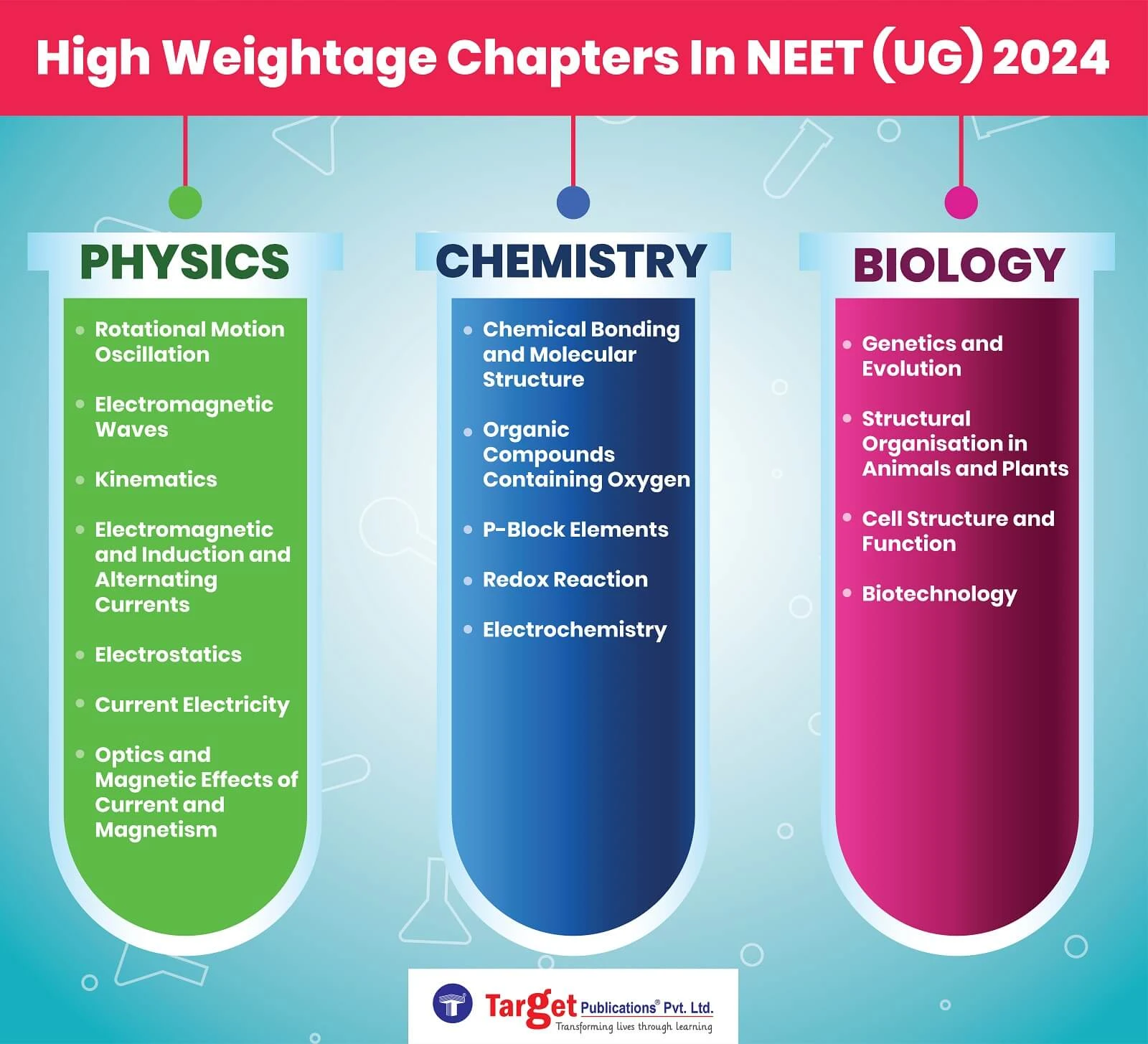
- Focus on the high-weightage chapters in NEET Physics such as Rotational Motion, Oscillation, Electromagnetic Waves, Kinematics, Electromagnetic and Induction and Alternating Currents, Electrostatics, Current Electricity, Optics and Magnetic Effects of Current and Magnetism.
- Keep a list of essential formulas readily available for quick review.
Chemistry:
- Concentrate your efforts on high-weightage chapters including Chemical Bonding and Molecular Structure, Organic Compounds Containing Oxygen, P-Block Elements, Redox Reaction, and Electrochemistry.
- Grasp reaction mechanisms thoroughly to effectively approach Chemistry problems.
- Regularly solve numerical problems to sharpen your problem-solving abilities.
Biology:
- Give special attention to high-weightage chapters such as Genetics and Evolution, Structural Organisation in Animals and Plants, Cell Structure and Function, and Biotechnology.
- Prepare yourself for calculation-based questions in chapters like Photosynthesis, Respiration, and Circulation.
- Practise diagrams and their labellings related to reproductive systems, excretory systems, and ecological concepts.
General Tips:
- Familiarise yourself with the exam pattern, including the number of questions, marking scheme, and duration of the exam. This will help you manage your time effectively during the exam.
- Utilise NEET-specific study materials, including textbooks, reference books, and online resources. Make sure to include NCERT textbooks as they are highly recommended for NEET preparation.
- Solve past NEET question papers to familiarise yourself with the exam format and the types of questions asked. This will also help you identify your strengths and weaknesses.
- Instead of rote memorisation, focus on understanding the concepts thoroughly.
On the day of the exam, start with questions you are most comfortable answering to build confidence. Manage your time wisely, and ensure to attempt all questions. However, be cautious of the negative marking and only attempt questions you are reasonably confident about. If uncertain, it might be better to skip a question rather than risk losing marks.
By diligently following the planner, applying the tips given in this blog and studying from the best NEET resources, you're not just preparing for an exam but laying the foundation for a fulfilling career in the medical field. However, amidst your preparation, it's essential to prioritise your health. Remember to maintain a balanced lifestyle by consuming nutritious meals, getting sufficient sleep, and engaging in activities that promote overall well-being.
Wishing you all the best for your upcoming exam! You've got this!
FAQs
1. How can I ensure I cover all the topics within the given time frame?
Ans: Familiarise yourself with the exam syllabus and weightage of topics. Follow the daily study plan provided in the blog for Physics, Chemistry, and Biology. Use efficient study techniques such as active recall and spaced repetition.
2. Is it possible to revise all the chapters in just five days?
Ans: Yes, with a focused revision strategy, you can effectively review key concepts and formulas. Prioritise areas of weakness and spend more time on challenging topics.
3. What should I do if I encounter difficulty with certain topics or concepts?
Ans: Break down complex concepts into smaller, more manageable parts for better understanding. You can also Seek clarification from your teachers, tutors, or online resources.
4. How should I approach the NEET exam day?
Ans: Arrive at the exam centre early to avoid any last-minute stress. Stay calm and focused during the exam. Read each question carefully and manage your time wisely. Avoid getting stuck on difficult questions and move on to maximise your chances of completing the exam.