You have spent months preparing for NEET, revising NCERT and solving mock tests. However, even small mistakes on examination day, such as forgetting a document or reaching the centre late, can create unnecessary problems.
A clear NEET exam day strategy helps you manage these practical responsibilities without disturbing your concentration. The goal is simple: reach the examination centre prepared, complete verification smoothly and enter the hall with a clear mind.
This guide covers the essential documents, reporting requirements, last-minute preparation and NEET exam day guidelines you should understand.
Before exam day arrives, practise following a similar routine during mocks. This guide on how to simulate the NEET exam environment at home can help you make the actual examination setting feel more familiar.
NEET Exam Day Preparation: What to Do the Previous Evening
Your NEET exam day preparation should begin the evening before the examination.
Avoid starting difficult chapters or attempting a challenging full-length mock test at the last moment.
Instead, focus on a few practical tasks:
- Check your admit card for the correct examination centre address.
- Plan your travel route and consider possible traffic delays.
- Arrange your required documents and photographs.
- Confirm the applicable reporting time and entry deadline.
- Prepare comfortable clothing that follows NTA instructions.
- Get adequate sleep.
For NEET exam preparation on the last day, limit academic revision to familiar formulae, reactions or short notes.
The objective is to preserve your concentration, not to complete unfinished chapters overnight.
NEET Exam Day Checklist: Documents to Carry
One of the most important questions students ask is about the documents to carry for NEET exam.
Based on the NEET UG 2026 instructions, the following checklist can help you prepare:
| Document | What You Should Check |
| Printed admit card | Downloaded from the official NTA portal with the required photograph |
| Passport-size photographs | Matching the photograph uploaded during registration; carry the quantity specified in the latest advisory |
| Postcard-size photograph | 4 × 6 inches, white background, affixed to the required admit-card proforma where instructed |
| Valid photo ID | An accepted identity document, following the admit-card instructions |
| PwBD-related certificate | Where applicable for the relevant examination facility or relaxation |
| Required declaration | Complete any self-declaration or undertaking attached to the admit card as instructed |
The exact things to carry for NEET exam may change between examination years. Always follow the latest official bulletin and your admit card.
Your admit card should be checked carefully because it contains important examination and centre-related instructions. You can refer to the previous NEET UG admit card release and instructions to understand the details students are expected to verify.
NEET Exam Centre Guidelines: Reporting and Entry
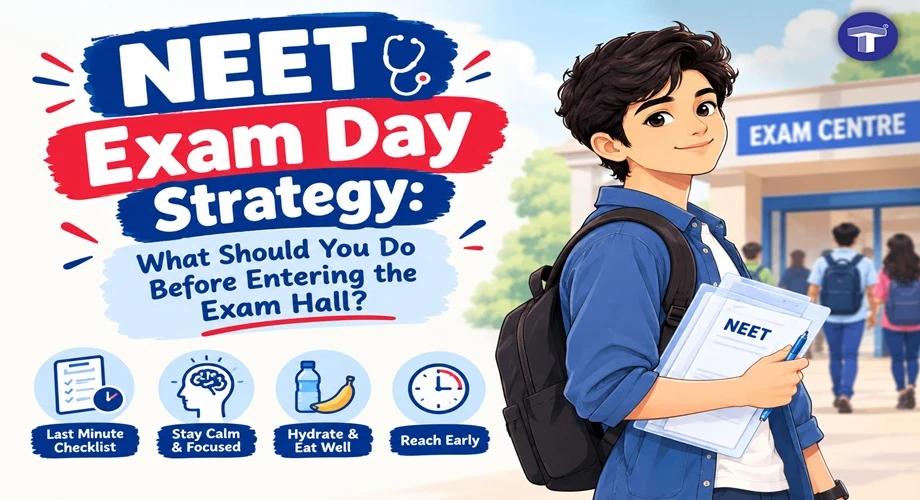
Reaching the examination centre early is one of the most effective NEET exam day tips.
For the regular NEET UG examination on May 3, 2026, NTA prescribed an entry window beginning at 11:00 AM, with gates closing at 1:30 PM.
This is a previous-year reference, not a confirmed schedule for future examinations.
Before leaving home, verify:
- The reporting time printed on your admit card
- The exact centre address and entrance
- Traffic and weather conditions
- Any special reporting instructions
Do not rely only on a map application's location pin. Cross-check the written address on your admit card.
Arriving early gives you enough time for identity verification, security screening and finding your allotted examination room.
NEET Exam Hall Instructions: What Is Not Allowed?
Understanding NEET exam hall instructions can prevent problems during security checks.
NTA's 2026 rules prohibited several items, including mobile phones, smartwatches, calculators, books, notes, wallets, handbags and electronic devices.
Candidates were also instructed not to bring their own stationery unless specifically permitted.
The April 2026 advisory allowed transparent water bottles. Therefore, you should check the latest permissible-items notice rather than relying only on older prohibited-items lists.
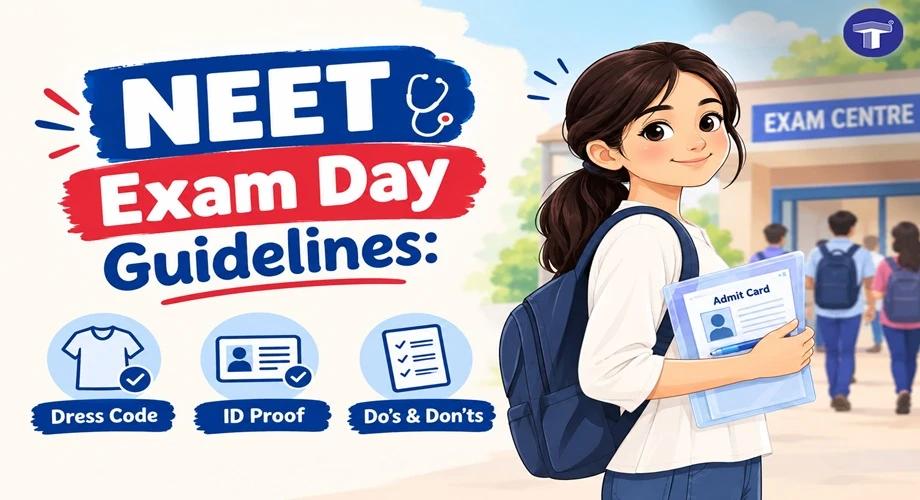
The examination dress code also matters.
Light clothing and slippers or sandals with low heels were preferred in 2026. Full sleeves, woollens and customary or religious attire were permitted subject to additional screening and early reporting.
For a detailed example of clothing and permissible-item instructions issued by NTA, read the NEET dress code and allowed items guidelines.
NEET Exam Day Routine: From Morning to Entry
A good NEET exam day routine should leave enough time for preparation without rushing.
| Stage | What You Should Do |
| After waking up | Eat a familiar breakfast and get ready |
| Before leaving | Check your documents and centre address |
| During travel | Avoid stressful last-minute discussions |
| At the centre | Follow the reporting, queue and security instructions |
| After verification | Find your allotted room and seat |
| Before the examination | Listen to the invigilator's instructions carefully |
Avoid arriving hungry, dehydrated or exhausted. You should also avoid experimenting with unfamiliar food or excessive caffeine immediately before the examination.
You can rehearse this routine before the actual examination by attempting full-length papers at the same time of day. The NEET-UG 10 Mock Papers and Solutions Booklet includes mock papers and OMR sheets for exam-style practice.
NEET Last-Minute Preparation Tips
Students often wonder what to do on NEET exam day while waiting to enter the centre.
This is not the time to compare preparation levels with other students.
You can briefly recall familiar concepts before entering, but stop studying once the centre's rules require you to put away your materials.
Useful NEET last-minute preparation tips include keeping your attention on the present task, avoiding rumours about the question paper and following the officials' instructions.
If you have a concern about your documents or verification, approach authorised centre staff rather than depending on advice from other candidates.
NEET Exam Day Stress Management
Feeling nervous before an important examination is common. For effective NEET exam day stress management, concentrate on actions within your control.
Try breathing slowly for a few moments and relax your shoulders. Avoid repeatedly calculating the score you need or comparing yourself with other students.
Remind yourself that one difficult question will not decide the entire examination. You have already completed your preparation. Your immediate responsibility is to follow instructions and apply what you know.
If examination pressure has been affecting your concentration, these NEET exam stress management tips can help you manage stress through practical routines before the examination.
Important Links
| NEET Exam Preparation: A Tailored Study Plan to Crack NEET | NEET 2026 Registration: Step-by-Step Process and Documents Required |
Final Advice
A successful NEET exam day begins before you receive the question paper. Prepare your documents, plan your journey, follow the latest centre guidelines and avoid unnecessary last-minute pressure.
A simple checklist and calm routine can help you concentrate on answering questions rather than worrying about preventable issues.
FAQs
1. What documents should I carry for the NEET examination?
Ans: Carry the printed admit card, required photographs, accepted identity proof and any applicable certificates or declarations. Follow the exact document list issued for your examination year.
2. How early should I reach the NEET examination centre?
Ans: Arrive well before the official last-entry time stated on your admit card. Allow additional time for traffic, security screening and identity verification.
3. Can I carry a water bottle into the NEET exam hall?
Ans: NTA permitted transparent water bottles for NEET UG 2026. Check the latest permissible-items advisory before your examination because rules may change.
4. Should I study on the morning of the NEET examination?
Ans: You can briefly revise familiar formulae or important points if it helps. Avoid new chapters, lengthy tests and last-minute preparation that increases stress.
5. What should I do if there is a problem during identity verification?
Ans: Inform authorised examination-centre staff immediately and follow their instructions. NTA has issued specific procedures for certain biometric-verification difficulties, so do not assume that a technical problem automatically prevents entry.