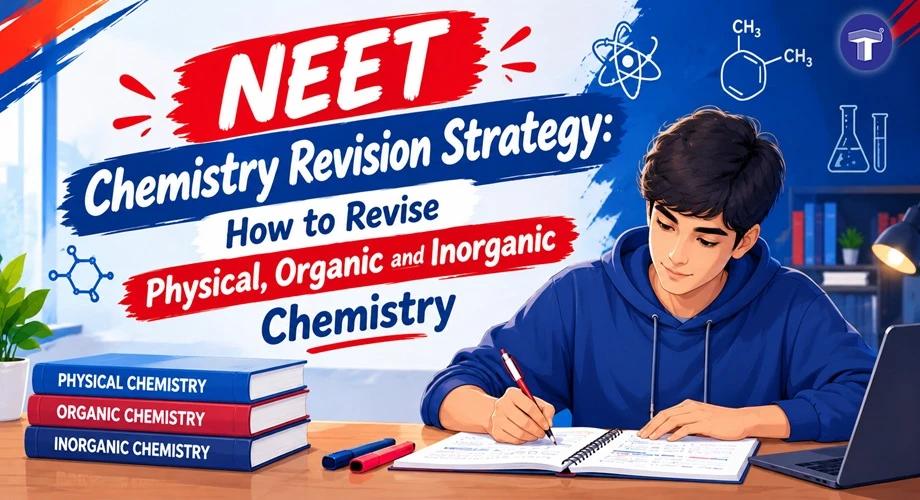
A good NEET Chemistry revision plan should not treat every chapter in the same way. Physical Chemistry requires numerical practice, Organic Chemistry needs an understanding of reactions, while Inorganic Chemistry depends heavily on concepts, trends and factual recall.
This is why reading all three sections repeatedly without a clear method may not improve your marks.
An effective NEET Chemistry revision strategy helps you decide what to memorise, what to practise and which topics need greater attention.
Let's understand how to revise each part of Chemistry without wasting time or repeating the same study activities.
Before deciding how much time to give each section, check the NEET Chemistry chapter-wise weightage and important topics to understand previous-year trends across Physical, Organic and Inorganic Chemistry.
How to Revise Chemistry for NEET
Before beginning revision, divide your Chemistry syllabus into Physical, Organic and Inorganic sections.
Each requires a different approach.
| Chemistry Section | Main Revision Focus | Recommended Practice |
| Physical Chemistry | Formulae, concepts and calculations | Timed numerical MCQs |
| Organic Chemistry | Reagents, mechanisms and conversions | Product prediction and reaction-based questions |
| Inorganic Chemistry | Trends, exceptions and properties | NCERT recall and statement-based MCQs |
Begin by identifying which section causes the most mistakes in your practice tests.
For example, if you remember Physical Chemistry formulae but struggle with calculations, spend additional time solving numericals instead of rereading theory.
Your revision should address the actual problem.
Physical Chemistry Revision for NEET
The best way to revise Physical Chemistry is through concept recall followed by numerical application.
Start by revising important formulae, their symbols, units and the conditions in which they apply.
Focus on syllabus areas such as:
- Mole Concept and Stoichiometry
- Chemical Thermodynamics
- Solutions
- Equilibrium
- Redox Reactions and Electrochemistry
- Chemical Kinetics
For each topic, solve a few basic numerical questions before attempting more challenging MCQs.
For detailed concept revision followed by chapter-wise MCQ practice, you can use NEET-UG & JEE-Main Chemistry Absolute Vol. 1 as part of your Physical Chemistry preparation.
Organic Chemistry Revision for NEET
The best way to revise Organic Chemistry is to connect reactions instead of memorising them individually.
Begin with General Organic Chemistry concepts such as electronic effects, reaction intermediates and reaction mechanisms.
Then organise reactions according to functional groups.
Your Organic Chemistry NEET revision should focus on:
- Hydrocarbons
- Organic Compounds Containing Halogens
- Organic Compounds Containing Oxygen
- Organic Compounds Containing Nitrogen
- Biomolecules
- Named reactions and important reagents
Prepare a reaction map connecting reactants, reagents, conditions and products.
Inorganic Chemistry NEET Revision
The best way to revise Inorganic Chemistry is through active recall and repeated reference to NCERT.
Unlike numerical-heavy chapters, many Inorganic topics require remembering chemical trends, properties, oxidation states and exceptions.
Give particular attention to:
- Classification of Elements and Periodicity
- p-Block Elements
- d- and f-Block Elements
- Coordination Compounds
- Relevant Chemical Bonding concepts
During Inorganic Chemistry NEET revision, study one topic and close your textbook. Then try recalling its important points without looking.
For structured theory and question practice across later Chemistry topics, you can also use NEET-UG & JEE-Main Chemistry Absolute Vol. 2 during your Organic Chemistry revision.
NEET Chemistry Important Topics to Revise First
Students often search for NEET Chemistry important topics when they have limited revision time.
However, the right priority depends on your understanding and previous test performance.
Use this approach:
| Topic Category | Revision Priority |
| Weak chapters with recurring mistakes | Revise immediately |
| Chapters with strong conceptual connections | Revise before dependent topics |
| Previously completed but forgotten chapters | Schedule quick recall sessions |
| Strong chapters with good accuracy | Maintain through short tests |
Important chapters such as Equilibrium, Electrochemistry, Coordination Compounds and Organic Chemistry fundamentals deserve attention, but do not exclude other topics from the official syllabus.
Chapter-wise weightage trends can guide additional practice. They should not replace complete syllabus preparation. To compare these priorities with broader exam trends, refer to the NEET chapter-wise weightage guide, while continuing to revise the complete prescribed syllabus.
NEET Chemistry Revision Timetable
A practical NEET Chemistry revision timetable should rotate the three sections while allowing enough time for practice and error correction.
Here is a sample seven-day schedule:
| Day | Revision Task |
| Monday | Physical Chemistry formulae and numericals |
| Tuesday | Organic Chemistry reaction maps |
| Wednesday | Inorganic Chemistry NCERT recall |
| Thursday | Physical Chemistry weak topics |
| Friday | Organic Chemistry conversions and reagents |
| Saturday | Inorganic Chemistry statement-based MCQs |
| Sunday | Mixed Chemistry test and mistake analysis |
This NEET Chemistry revision plan can be repeated with different chapters every week.
To make this weekly cycle more effective, use techniques such as active recall, spaced revision and regular self-testing. These revision techniques for NEET and other entrance exams can help you structure repeated revision better.
How to Make Chemistry Revision Notes for NEET
Your Chemistry revision notes for NEET should help you remember information quickly.
Prepare different types of notes for each section.
| Section | What Your Notes Should Contain |
| Physical | Formulae, units, conditions and calculation traps |
| Organic | Reaction maps, reagents, products and exceptions |
| Inorganic | Trends, oxidation states, properties and NCERT facts |
Avoid copying full textbook paragraphs.
Keep notes short enough to review before chapter tests. Add new information only when a practice question reveals a genuine gap.
How to Check Whether Your Revision Is Working
Reading a chapter multiple times does not necessarily mean you can answer its questions correctly.
After completing a revision cycle, take a timed Chemistry test covering the topics you studied.
Check three things:
- Accuracy: How many questions did you answer correctly?
- Error pattern: Were mistakes caused by concepts, memory or calculations?
- Retention: Can you solve similar questions a few days later without referring to notes?
If accuracy remains low, return to the specific weak concept rather than repeating the entire chapter.
This helps make every revision session more useful. For topic-wise self-assessment before moving to full mock papers, you can also read about the NEET UG topic-wise test series with solutions.
Important Links
| How to Analyse NEET Mock Test Mistakes Effectively | 39 Years NEET Chemistry Previous Solved Papers |
Final Advice
A strong NEET Chemistry revision strategy combines three different methods: numerical practice for Physical Chemistry, reaction mapping for Organic Chemistry and active recall for Inorganic Chemistry. Revise according to your weaknesses, test your understanding and correct repeated mistakes.
FAQs
1. How should I revise Chemistry for NEET effectively?
Ans: Divide Chemistry into Physical, Organic and Inorganic sections. Use numerical practice for Physical Chemistry, reaction maps for Organic Chemistry and NCERT-based recall for Inorganic Chemistry.
2. How many hours should I spend on NEET Chemistry revision?
Ans: Around 1–2 focused hours daily can be a starting point, depending on your overall timetable. Adjust the duration according to your weaker sections and pending syllabus.
3. Is NCERT enough for NEET Chemistry revision?
Ans: NCERT is an important foundation, especially for Inorganic and Organic Chemistry. However, numerical practice, MCQs, PYQs and mock tests are also necessary for effective exam preparation.
4. What is the best way to revise Organic Chemistry reactions?
Ans: Group reactions by functional groups and conversions. Revise reagents, conditions and products together, then practise product-prediction questions.
5. Should I revise Physical, Organic and Inorganic Chemistry every day?
Ans: Not necessarily. You can rotate sections throughout the week while keeping short recall sessions for topics you forget frequently.