
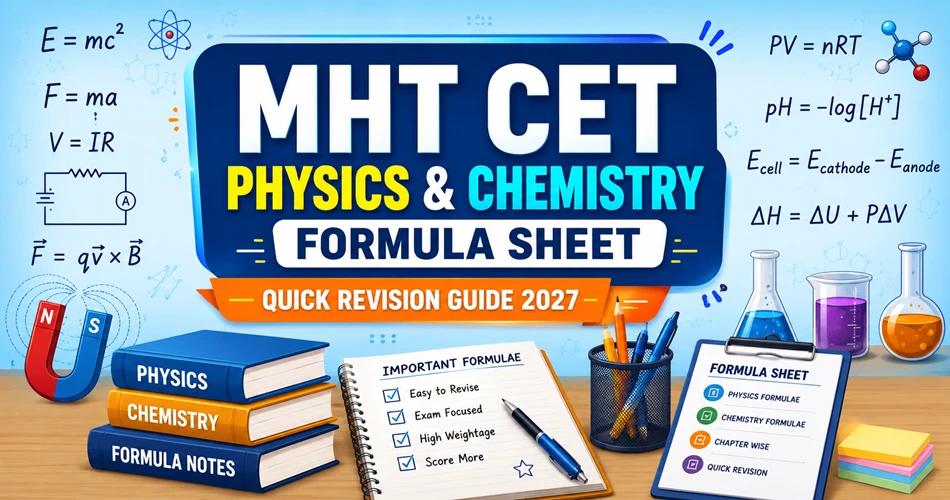
Success in MHT-CET depends not only on conceptual understanding but also on the ability to recall and apply formulae quickly during the examination. Since Physics and Chemistry contain numerous numerical and application-based questions, maintaining a well-organised MHT CET formula sheet can significantly improve speed and accuracy.
This guide highlights the most important formulae and revision strategies that can help you strengthen your preparation.
Why Formula Revision Matters for MHT-CET
The MHT-CET syllabus is based on the Maharashtra State Board curriculum, with a strong emphasis on Class 11 and Class 12 topics. Many Physics and Chemistry questions require direct application of formulae. Therefore, creating an MHT CET formula list and revising it regularly is essential for effective preparation. You should maintain separate sections for Physics and Chemistry and update your notes throughout the preparation period.
Important Physics Formulae for MHT-CET
A dedicated MHT CET physics formula sheet should cover the following high-weightage topics:
1. Kinematics
- v = u + at
- s = ut + ½at²
- v² = u² + 2as
2. Laws of Motion
- F = ma
- Momentum (p) = mv
- Impulse = Force × Time
3. Work, Power and Energy
- Work = Force × Displacement
- Kinetic Energy = ½mv²
- Potential Energy = mgh
- Power = Work/Time
4. Gravitation
- F = Gm₁m₂/r²
- g = GM/R²
5. Electrostatics
- Coulomb's Law:
F = kq₁q₂/r²
- Electric Potential:
V = W/q
6. Current Electricity
- Ohm's Law:
V = IR
- Electrical Power:
P = VI
7. Magnetism
- Magnetic Force:
F = qvB sinθ
8. Optics
- Lens Formula:
1/f = 1/v − 1/u
- Magnification:
m = v/u
9. Modern Physics
Important modern physics formulas include:
- E = mc²
- E = hν
- λ = h/p
These are among the most frequently used physics formulas for MHT CET and should be revised repeatedly before the examination.
Important Chemistry Formulae for MHT-CET
You should also prepare a separate MHT CET chemistry formula sheet for quick revision.
1. Mole Concept
- Number of Moles = Given Mass/Molar Mass
- Avogadro Number = 6.022 × 10²³
2. Gas Laws
- PV = nRT
- P₁V₁/T₁ = P₂V₂/T₂
3. Solutions
- Molarity = Moles of Solute/Volume of Solution
4. Chemical Kinetics
- Rate = k[A]ⁿ
5. Electrochemistry
- Ecell = Ecathode − Eanode
6. Thermodynamics
- ΔH = ΔU + PΔV
7. Surface Chemistry
- Adsorption-related numerical formulae and percentage calculations
8. Ionic Equilibrium
- pH = −log[H⁺]
- pOH = −log[OH⁻]
These physical chemistry formulas form a major part of numerical problem-solving and should be included in your revision notes.
MHT CET Chapter Wise Formulas Strategy
Instead of memorising formulae randomly, organise your MHT CET chapter wise formula into concise notes.
A recommended approach is:
- One-page summary for each chapter
- Separate colour coding for Physics and Chemistry
- Highlight frequently used equations
- Include unit conversions and constants
- Add commonly confused formulae
These MHT CET formula notes can be revised during short study sessions and before mock tests.
Quick Revision Tips
An effective MHT CET quick revision plan should focus on consistency rather than lengthy study sessions.
Create Short Notes
Prepare concise MHT CET short notes containing:
- Formulae
- Important constants
- Key definitions
- Frequently used derivations
Use Flashcards
Digital or physical flashcards help improve recall speed and are particularly useful during the final month before the examination.
Revise Daily
Spend 15–20 minutes each day reviewing your MHT CET important formulas rather than attempting to memorise everything at once.
Practise Formula-Based Questions
Apply formulae through chapter-wise questions and mock tests. This improves retention and reduces calculation errors.
MHT CET Preparation Strategy for Formula Mastery
A practical MHT CET preparation strategy includes:
- Learn the concept before memorising the formula.
- Create a personalised MHT CET formula sheet.
- Revise formulae weekly.
- Solve previous-year questions.
- Analyse mistakes after every mock test.
- Focus on high-weightage numerical chapters.
This approach helps you develop both speed and accuracy, which are essential for achieving a strong score.
FAQs
1. How many formulae should I memorise for MHT-CET Physics and Chemistry?
Ans: There is no fixed number. You should focus on all standard formulae from high-weightage chapters and maintain a consolidated revision notebook.
2. Which MHT-CET chapters have the highest number of formula-based questions?
Ans: In Physics, Current Electricity, Electrostatics, Optics, Magnetism and Modern Physics are important. In Chemistry, Mole Concept, Thermodynamics, Chemical Kinetics, Electrochemistry and Ionic Equilibrium frequently contain formula-based questions.
3. How often should I revise formulae before the MHT-CET exam?
Ans: Formulae should ideally be revised daily and reviewed comprehensively once every week. Frequent revision improves long-term retention.
4. Can formula flashcards help in MHT-CET preparation?
Ans: Yes. Flashcards are highly effective for memorising equations, constants and unit conversions while improving recall speed during examinations.
5. Are formula-based questions easier than conceptual questions in MHT-CET?
Ans: They can be easier if you understand the underlying concepts and know when to apply the correct formula. Memorisation alone is not sufficient.
6. What are the most common formula mistakes students make in MHT-CET?
Ans: Common errors include using incorrect units, applying the wrong formula, forgetting conversion factors, calculation mistakes and confusion between similar equations.
A well-structured MHT CET physics formula sheet and MHT CET chemistry formula sheet can make revision more organised and efficient. By preparing chapter-wise notes, revising regularly and practising numerical problems, you can improve both confidence and performance. Consistent revision of the most important physics formulas for MHT CET and Chemistry equations remains one of the simplest ways to maximise examination readiness.
Important Links
| MHT CET Books for Reference: PYQs and Chapter-wise MCQs | How Hard Is MHT CET in 2026? Complete Difficulty Analysis for PCM and PCB |