
It is 8 February, 2026. In exactly 48 hours, you will be sitting in an exam hall with an answer sheet, writing your first HSC Board paper. Your desk is likely a chaotic graveyard of Science notes, filled with run out highlighters, and scattered thoughts waiting to be organised.
But in the back of your mind, there’s a louder clock ticking: The MHT CET 2026.
With the first session of CET scheduled for 11–19 April, you have precisely 60 days to bridge the gap between ‘passing Boards’ and ‘achieving the top percentile.’
Std. 12 Boards are the ‘Hidden’ CET Preparation
Stop feeling guilty about studying for Boards. The MHT CET 2026 syllabus is 80% Std. 12 content. Every time you memorise a derivation for Physics or a reaction mechanism for Chemistry for your Board paper, you are actually building some of your CET foundation.
Phase 1: The ‘Dual-Purpose’ Sprint (Days 1–25)
Timeline: During HSC Board Exams (10 February–10 March)
Your focus is naturally on Boards, but you can optimise your study sessions for ‘CET’ with two simple habits:
- The ‘Formula Snippet’ Rule: After finishing a chapter for Boards, spend 10 minutes looking at the MHT CET Previous Year Questions (PYQs) for that specific chapter. Don't solve them all, just see how the Board theory turns into an MCQ.
- Textbook Scanning: CET also has direct lines from the State Board textbook. Treat your textbook well during Boards.
Phase 2: The Post-Board Pivot (Days 26–45)
Timeline: The ‘Golden Month’ (11 March – 31 March)
Once the Board exams end, you have roughly three weeks of pure, uninterrupted preparation. This is where you tackle the 20% Std. 11 syllabus and the high-weightage topics.
Std. 11 Syllabus for MHT CET 2026 (The 20% Factor)
Don't get stuck. Focus only on the Std. 11 chapters specified by the State CET Cell:
| Std. 11 PHYSICS | |
| Chapters | Sub-Topics |
| Electrostatics | Electric charges, Coulomb’s law, field and potential |
| Error Analysis | Types of errors, accuracy, precision, and significant figures |
| Gravitation | Universal law, acceleration due to gravity, Kepler’s laws |
| Laws of Motion | Newton’s laws, friction, circular motion dynamics |
| Motion in a Plane | Projectile motion, uniform circular motion |
| Optics | Reflection, refraction, lenses, mirrors, optical instruments |
| Semiconductors | Intrinsic/extrinsic semiconductors, diodes, transistors |
| Sound | Wave motion, speed of sound, Doppler effect |
| Thermal Properties of Matter | Heat, temperature, specific heat, calorimetry |
| Vectors | Concepts of vectors, addition, subtraction, and multiplication of vectors |
| Std. 11 CHEMISTRY | |
| Chapters | Sub-Topics |
| Some Basic Concepts of Chemistry | Mole concept, stoichiometry, laws of combination |
| Structure of Atom | Quantum mechanical model, electronic configuration |
| Chemical Bonding | Ionic, covalent, metallic bonds, VSEPR theory, hybridization |
| States of Matter (Gases and Liquids) | Ideal and real gases, liquefaction |
| Redox Reactions | Oxidation numbers, balancing equations |
| Elements of Groups 1 and 2 | Alkali and alkaline earth metals |
| Adsorption and Colloids (Surface Chemistry) | Physisorption, chemisorption, emulsions |
| Hydrocarbons | Alkanes, alkenes, alkynes, aromatic hydrocarbons |
| Basic Principles of Organic Chemistry | Nomenclature, isomerism, effects |
| Chemistry in Everyday Life | Drugs, detergents, food additives |
| Std. 11 MATHEMATICS | |
| Chapters | Sub-Topics |
| Vectors | Concepts of vectors, addition, subtraction, and multiplication of vectors |
| Error Analysis | Types of errors, accuracy, precision, and significant figures |
| Motion in a Plane | Projectile motion, uniform circular motion |
| Laws of Motion | Newton’s laws, friction, circular motion dynamics |
| Gravitation | Universal law, acceleration due to gravity, Kepler’s laws |
| Thermal Properties of Matter | Heat, temperature, specific heat, calorimetry |
| Sound | Wave motion, speed of sound, Doppler effect |
| Optics | Reflection, refraction, lenses, mirrors, optical instruments |
| Electrostatics | Electric charges, Coulomb’s law, field and potential |
| Semiconductors | Intrinsic/extrinsic semiconductors, diodes, transistors |
| Std. 11 BIOLOGY | |
| Chapters | Sub-Topics |
| Biomolecules | Carbohydrates, proteins, lipids, nucleic acids, enzymes |
| Respiration and Energy Transfer | Aerobic/anaerobic respiration, glycolysis, Krebs cycle |
| Human Nutrition | Nutrients, functions, requirements, malnutrition |
| Excretion and Osmoregulation | Excretory systems, urine formation, osmoregulation |
Subject-Specific High Weightage Chapters for MHT CET 2026
If you are short on time, prioritise these high-weightage chapters. They historically contribute to nearly 60% of the paper.
| Subject | Must-Do Chapters (High Weightage) |
| Physics |
|
| Chemistry |
|
| Mathematics |
|
Phase 3: The Exam Stamina Improvement (Days 46–60)
Timeline: The Final Countdown (1 April–11 April)
This phase is about stamina. The MHT CET is a 3-hour test of speed. If you haven't trained your brain to sit for 180 minutes without a phone break, you will not be able to do it during the actual exam either.
The ‘90–90’ Mock Strategy
- Morning (9:00 a.m–12:00 p.m.): Take a full-length mock test. No excuses.
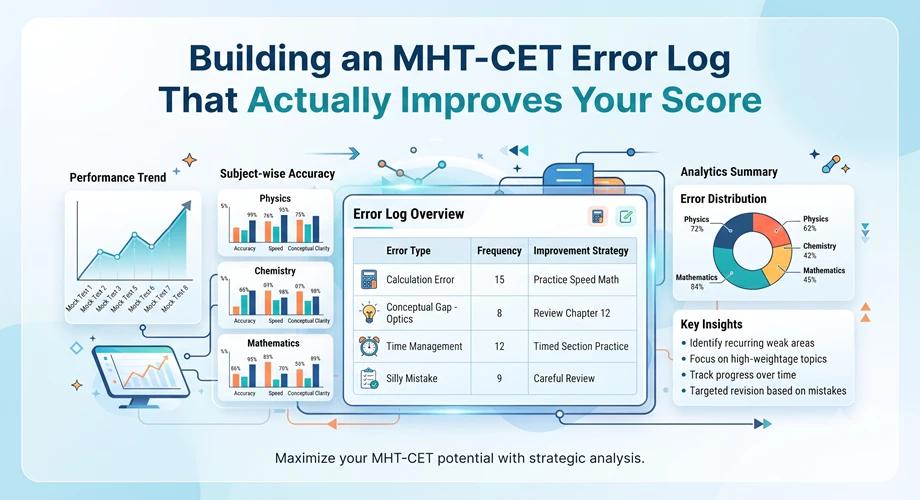
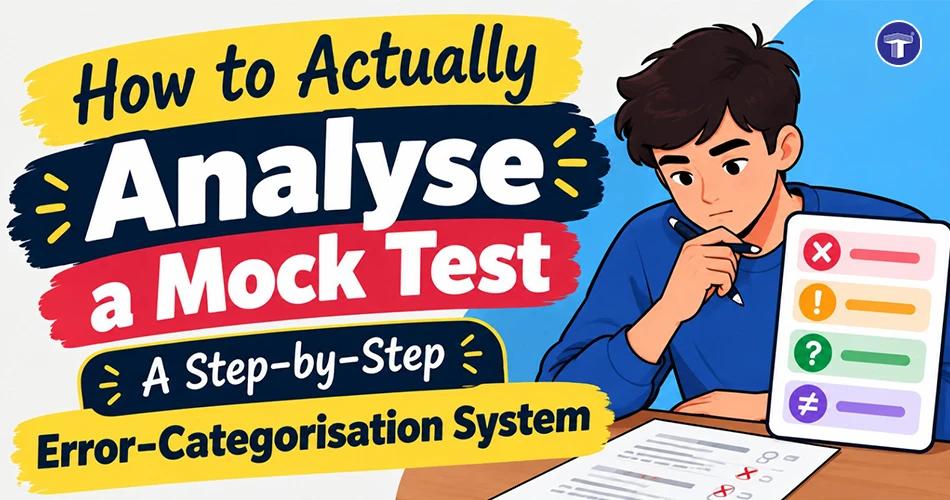
- Afternoon (2:00 p.m–5:00 p.m.): Deep Analysis. Did I get it wrong because of a concept? (Revise). Did I get it wrong because of a calculation? (Practise increasing speed). Did I run out of time? (Adjust the order of subjects).
The 2026 Two Attempts Advantage
For the first time, you have two attempts for MHT CET 2026 exam (April and May).
- Session 1 (April): Your goal is to ace it here. Don't ‘save’ your effort for May.
- Session 2 (May): Use this to fix the gaps identified in Session 1.’
How ‘No Negative Marking’ Can Be Utilised
Since there is no penalty for guessing, the cut-offs for top MHT CET colleges like COEP, VJTI, and ICT are sky-high (usually 99.5+ percentile).
You don't just need to be right in your answers; you need to be fast so you have time to intelligently guess the ones you don't know. Since the ‘0’ part is guaranteed, never—ever—leave a bubble unclicked.
To Sum It Up
The next MHT CET 60 days will go by in a blink. Your immediate task is to crush the English paper on the 10th. But every night, remind yourself that the effort you put into Boards is the fuel for your CET fire.