
Let’s be honest—when we think about MHT CET, we mostly think about the syllabus, strategy, and stress. But have you ever paused to ask: Who’s actually conducting this exam? What really goes on behind the login screen?
Because behind every question you answer, every click you make, and every section timer that stresses you out… there’s a full-fledged operation running in the background.
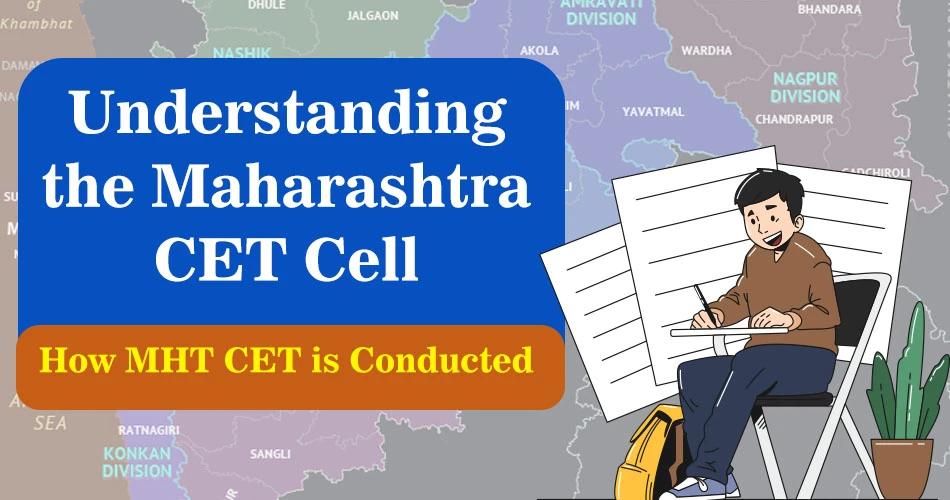
Welcome to the world of the State CET Cell, Maharashtra. The powerful force managing one of the most competitive entrance exams in the state.
This blog isn’t just about what the CET Cell Maharashtra is. It’s about how they manage it—start to finish.
What Is the Maharashtra CET Cell?
The State Common Entrance Test Cell is the official body responsible for conducting entrance exams for professional courses in Maharashtra.
Whether it’s Engineering, Pharmacy, Agriculture, Law, or Education—if a Common Entrance Test is involved in Maharashtra, the CET Cell is the authority behind it.
Here is a quick overview of the CETs conducted by the Maharashtra CET Cell:
| Sr. No. | CET Name | Mode of CET | Departments |
| 1 | MBA/MMS-CET | Online | Technical Education |
| 2 | MCA CET | Online | Technical Education |
| 3 | B.HMCT | Online | Technical Education |
| 4 | M.ARCH | Online | Technical Education |
| 5 | M.HMCT | Online | Technical Education |
| 6 | B.Design | Offline | Technical Education |
| 7 | MHT CET (B.Engineering, B.Pharmacy, Agriculture and B.Planning) | Online | Technical Education |
| 8 | BA B.Sc B.Ed | Online | Higher Education |
| 9 | B.Ed-M.Ed-CET | Online | Higher Education |
| 10 | L.L.B.5 Yrs. | Online | Higher Education |
| 11 | M.P.Ed. CET | Online | Higher Education |
| 12 | B.Ed (General and Special) and B.Ed ELCT-CET | Online | Higher Education |
| 13 | L.L.B.3 Yrs. | Online | Higher Education |
| 14 | B.P.Ed.-CET | Online | Higher Education |
| 15 | M.Ed CET | Online | Higher Education |
| 16 | MAH-AAC CET | Offline | Art Education |
| 17 | B.Sc. Nursing | Online | Medical Education |
| 18 | PGP-CET/PGO-CET/M.Sc(A & SLP)-CET/ M.Sc (P&O)-CET | Online | Medical Education |
While the CET Cell conducts various entrance tests across disciplines, MHT CET is its flagship exam for engineering and pharmacy admissions.
The full form of MHT CET is Maharashtra Health and Technical Common Entrance Test. It’s a large-scale and digitally administered test that demands meticulous planning and execution.
In fact, the groundwork for MHT CET starts months before students even begin registering.
From setting the syllabus to finalising the schedule, the CET Cell Maharashtra manages it all with precision. Important updates and detailed MHT CET exam information are regularly published on the CET Cell official website, making it the go-to source for aspirants.
So, how exactly is this massive exam conducted?
Step 1: Setting the MHT CET Syllabus and Structure
Before any student even fills out a form, the CET Cell begins its work for the MHT CET exam.
Each year, the MHT CET syllabus is declared in consultation with the Directorate of Technical Education (DTE). The content is based on the Maharashtra State Board curriculum, with:
- 80% weightage from Class 12
- 20% weightage from Class 11
But deciding what to study isn’t the only thing that happens early. The difficulty level is also defined as follows:
- Mathematics questions follow the JEE (Main) level
- Biology questions are aligned with NEET standards
Once the syllabus is finalised, the CET Cell releases the detailed information brochure for MHT CET and begins preparing for registrations.
Step 2: Designing the MHT CET Exam Pattern
With the MHT CET syllabus in place, the CET Cell then turns its attention to how the exam will be conducted.
MHT CET 2025 is a Computer-Based Test (CBT) and includes only Multiple Choice Questions (MCQs). In this exam, section-locking is followed. Once a section’s time limit is over, students cannot return to it, keeping the test strictly time-bound.
For Engineering (PCM Group):
| Subject | Questions (XI + XII) | Marks per Question | Duration |
| Mathematics | 10 + 40 | 2 | 90 minutes |
| Physics + Chemistry | 10 + 40 (each) | 1 | 90 minutes |
For Pharmacy (PCB Group):
| Subject | Questions (XI + XII) | Marks per Question | Duration |
| Biology | 20 + 80 | 1 | 90 minutes |
| Physics + Chemistry | 10 + 40 (each) | 1 | 90 minutes |
And here’s how the CET Cell ensures that the testing process remains smooth, fair, and student-focused:
- There is no negative marking in MHT CET. Students are encouraged to attempt all questions without the fear of score deduction.
- Language flexibility is offered. Mathematics is available only in English, while Physics, Chemistry, and Biology can be taken in English, Marathi, or Urdu.
- Separate centers may be allotted to candidates opting for both PCM and PCB groups, depending on logistics and availability.
Step 3: CET Cell Sets Eligibility for MHT CET and the Admission Process Begins
Once the exam structure is published, eligibility criteria is established for the MHT CET exam.
The eligibility criteria for MHT CET is as follows:
- Candidates must be Indian nationals.
- As per the MHT CET domicile criteria, applicants should be residents of Maharashtra. However, candidates from other states are also eligible to apply.
- There is no age limit for candidates appearing in the MHT CET exam.
- There are no limits on the number of attempts for MHT CET.
- You must have passed the 10+2 or an equivalent examination from a recognised Board/university with Physics, Chemistry, and Mathematics.
- They must secure the minimum passing marks applicable for MHT CET.
- General category candidates need at least 45 percentage in Class 12th for MHT CET. For reserved category students, the minimum percentage required is 40%.
Next, the CET Cell Maharashtra begins the MHT CET application process through its official website.
As part of the admission process, the CET Cell mandates students to register and fill out the application form. The process is as follows:
- Register on the official website
- Fill out academic and personal details
- Upload scanned documents and photos in the application form
- Pay the fees
- Submit your application form
The CET Cell follows a well-defined schedule each year, right from application to result declaration. The timeline for MHT CET 2025 serves as a clear example of how the process is structured and managed:
| Event | Date Range |
| Application Window | 30 Dec, 2024 – 15 Feb, 2025 |
| Late Registration (with fee) | 16 Feb – 22 Feb, 2025 |
| Admit Card Release | April, 2025 |
| Exam Dates (PCM/PCB) | PCB: 09 to 17 April, 2025 PCM: 19 to 27 April, 2025 |
| Result Declaration | PCB: 17 June, 2025 PCM: 16 June, 2025 |
Step 4: Preparations for MHT CET Exam Day
While you’re focusing on Physics or solving Mathematics problems, here’s what the CET Cell ensures on the back-end:
- Reporting times are strictly followed
- Biometric and ID verification is mandatory.
- Electronic devices are not allowed.

MHT CET examination hall
The CET Cell appoints a designated Venue Officer to each centre to handle grievances like system errors or technical glitches during the exam.
Students who arrive late or without ID are not allowed to enter. Every detail is designed to protect the exam's integrity.
Step 5: Fairness Across Shifts and How Scores Are Normalized
Since MHT CET is conducted over multiple sessions, question difficulty can slightly vary. To ensure no student is unfairly impacted by the specific paper they were given, the CET Cell uses a percentile-based normalization method.
- Your percentile score reflects how you performed compared to others in your shift.
- For example: A score of 99.5 percentile means you performed better than 99.5% of test-takers in that session.
- The exact MHT CET normalization methodology is released separately by CET Cell for transparency.
Step 6: The CAP Counselling Process After the Results
Once the MHT CET results are declared, the CET Cell initiates the Centralized Admission Process (CAP), a streamlined, fully online system that governs seat allotment across participating institutions in Maharashtra.
To ensure fairness, transparency, and ease of access, the CET Cell follows a structured counselling flow:
- Activating the official MHT CET CAP website: fe2025.mahacet.org
- Enabling document upload and verification through e-scrutiny or physical facilitation centers
- Publishing the MHT CET Provisional and Final Merit Lists for eligible candidates
- Opening the option form to fill in college and course preferences
- Conducting multiple rounds of seat allotment (typically Rounds I–IV) based on merit, category, and seat availability
- Allowing students to accept the allotted seat and report to the respective institute within the given timeline
By keeping the entire process digital, the CET Cell ensures that admissions are merit-driven and transparent, with every action—from verification to final reporting—being track-able and time-bound.
Final Thought
The CET Cell doesn’t just conduct an entrance exam. It manages a turning point in thousands of students’ lives. From every shift and score to each seat allotment, the CET Cell ensures the entire process is fair, transparent, and driven purely by merit.
All you need to do is show up prepared. The rest is taken care of.
Frequently Asked Questions (FAQs)
1. What happens if a technical glitch occurs during the MHT CET exam?
Ans: Depending on the issue, the CET Cell Maharashtra takes a decision. In such cases, students may receive extra time or be rescheduled for a retest.
2. What are the common reasons for MHT CET application form rejection?
Ans: Application forms usually get rejected when important details are missing, documents aren’t valid, or the fees haven’t been paid on time.
3.How does CET Cell handle fraudulent activities or impersonation cases during the exam?
Ans: To catch any kind of cheating or impersonation, the CET Cell uses biometric scans, CCTV cameras, document verification, and checks. If someone violates the rules, they’re disqualified and serious action is taken against them.
4. How does CET Cell decide the location of exam centers across Maharashtra?
Ans: The CET Cell sets up exam centers by looking at where most students are applying from, how easily a place can handle the exam setup, and the preferences students give. So that everyone gets a centre that’s reasonably close and convenient.