
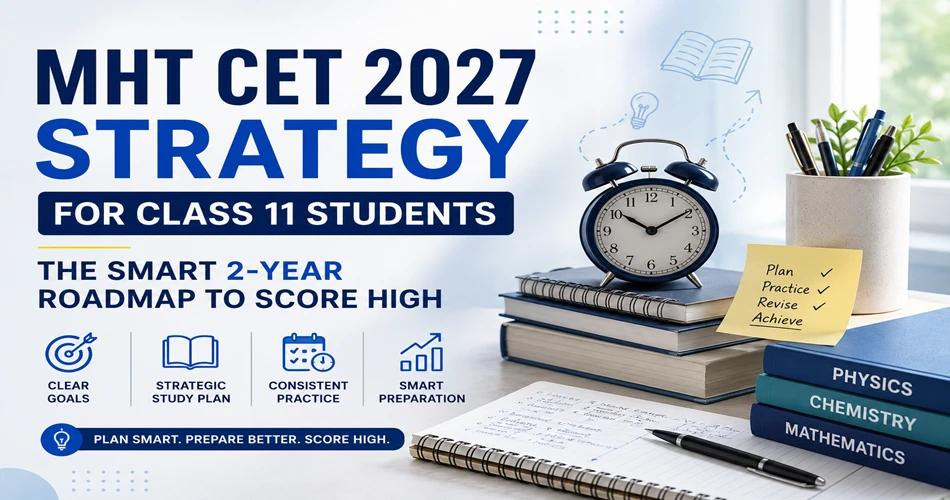
If you're currently in Class 11 and aiming for MHT CET 2027, you're at the perfect stage to build a strong foundation. While many students postpone preparation, toppers use Class 11 to master concepts, improve problem-solving speed, and develop exam confidence.
The right MHT CET 2027 strategy isn't about studying for long hours; it's about studying smart, staying consistent, and following a structured roadmap. Here's everything you need to know to make your two-year preparation count.
Why Class 11 Is the Foundation of MHT CET Success
Although the MHT CET syllabus gives greater weightage to Class 12 topics, many advanced concepts are built upon Class 11 fundamentals.
Some important Class 11 chapters include:
- Vectors
- 3D Geometry
- Integration (basics)
- Oscillations
- Electrostatics
- Thermodynamics
- Kinetic Theory of Gases
- Organic Chemistry fundamentals
These topics connect directly with higher-level concepts you'll study in Class 12.
Strong basics today mean easier learning tomorrow.
Why Early MHT CET Preparation Matters
Competition for Maharashtra's top engineering colleges has increased steadily over the years. As cut-offs continue to rise, simply completing the syllabus is no longer enough.
Students who begin preparation in Class 11 usually gain:
- Better conceptual understanding
- More time for revision
- Improved solving speed
- Less pressure during Class 12
- Higher confidence during mock tests
Preparing early gives you enough time to learn, practice, revise, and improve without unnecessary stress.
Common Mistakes Class 11 Students Make
Many students unknowingly reduce their chances of scoring well by following ineffective study habits.
Some common mistakes include:
- Treating Class 11 casually
- Studying only for school examinations
- Delaying MCQ practice
- Memorising instead of understanding concepts
- Ignoring regular revision
- Waiting until Class 12 to start serious preparation
These mistakes create unnecessary pressure later when board exams and entrance preparation overlap.
Understand the MHT CET Exam Pattern Before You Start
Planning becomes much easier once you understand how the exam works.
| Feature | MHT CET |
| Exam Type | Computer-Based Test |
| Questions | Multiple Choice Questions (MCQs) |
| Negative Marking | No |
| Focus Areas | Speed + Accuracy + Concept Clarity |
| Subjects | Physics, Chemistry, Mathematics & Biology (PCMB) |
Since there is no negative marking, attempting more questions accurately can significantly improve your score. That's why building solving speed from Class 11 is essential.
MHT CET 2027 Preparation Strategy for Class 11 Students
Instead of studying randomly, follow a systematic preparation cycle.
Step 1: Build Strong Concepts
Focus on understanding the "why" behind every concept.
- Understand Physics formulas instead of memorising them.
- Learn mathematical logic and problem-solving patterns.
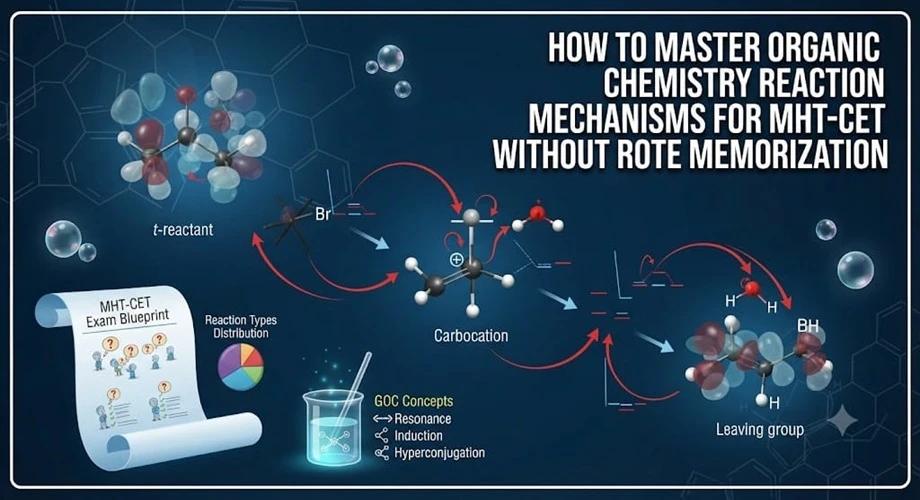
- Study Chemistry reactions with conceptual understanding.
Strong concepts reduce confusion while solving difficult MCQs.
Step 2: Practice MCQs Daily
Objective practice should begin alongside chapter completion.
Aim to solve:
- 25–40 MCQs after every topic
- Mixed-topic questions every week
- Difficulty-level questions gradually
Consistent MHT CET MCQ practice improves speed and accuracy over time.
Step 3: Follow a Weekly Revision Cycle
A simple routine works best.
- Learn the concept.
- Solve objective questions.
- Take a timed chapter test.
- Revise within seven days.
- Note down mistakes.
This method improves retention and reduces last-minute revision pressure.
Best Study Material for MHT CET
Many students make the mistake of collecting too many books.
Instead, follow this order:
- Maharashtra State Board Textbooks
- Chapter-wise MCQ practice books
- Previous year MHT CET papers
- Test series
- Error notebook for revision
Depth of learning is always better than studying from multiple sources.
Your Two-Year MHT CET Roadmap
Class 11
- Build strong fundamentals
- Complete every chapter thoroughly
- Practice MCQs regularly
- Develop solving speed
- Revise every week
Class 12
- Focus on high-weightage chapters
- Attempt full-length mock tests
- Analyse mistakes after every paper
- Strengthen weak topics
- Improve exam temperament
Following this roadmap makes preparation manageable and reduces stress before the exam.
How Many Hours Should You Study Daily?
One of the most common questions students ask is about study hours.
A practical target is:
- 2–3 focused hours daily for MHT CET preparation (apart from school studies)
- More hours during vacations or weekends if required
Remember:
Studying consistently for two years is much more effective than studying excessively only during Class 12.
Expert Tips to Crack MHT CET 2027
Improve your preparation by following these proven practices:
- Finish school concepts before moving to advanced questions.
- Maintain a formula and revision notebook.
- Solve timed quizzes every week.
- Analyse every mock test instead of only checking scores.
- Revise difficult chapters multiple times.
- Avoid comparing your progress with others.
- Stay consistent even during school examinations.
Small improvements every day lead to significant results over two years.
Quick Preparation Checklist
Before moving to Class 12, make sure you have:
✔ Completed major Class 11 concepts
✔ Practised chapter-wise MCQs
✔ Started solving timed tests
✔ Revised important chapters multiple times
✔ Identified weak subjects
✔ Built a regular study routine
If you can confidently check these boxes, you're already ahead of many aspirants.
Conclusion
If you're in Class 11 today, you have something every MHT CET topper values-time.
Use this year to build strong fundamentals, develop speed through regular MCQ practice, revise consistently, and follow a structured two-year preparation plan. You don't need to study endlessly; you need to study strategically.
The competition for MHT CET 2027 will be intense, but students who begin early with the right roadmap will always have an advantage. Start now, stay consistent, and let every small step bring you closer to your dream engineering college.
Important Links
| MHT CET Syllabus 2027: Complete Subject-Wise Guide, Weightage, PDF and Preparation Tips | Your Complete Guide to the Best MHT CET Books for PCM & PCB |
Frequently Asked Questions (FAQs)
1. How many chapters should Class 11 students complete each month for MHT CET 2027?
Ans: Aim to complete 2–4 chapters per subject every month, depending on your school schedule. Focus on understanding concepts thoroughly rather than rushing through the syllabus.
2. Is it possible to prepare for MHT CET 2027 without joining coaching classes?
Ans: Yes. With discipline, Maharashtra State Board textbooks, quality MCQ practice, mock tests, and regular revision, many students prepare successfully on their own. Coaching can provide additional guidance, structured planning, and performance tracking if you need extra support.
3. How much time should Class 11 students dedicate daily to MHT CET preparation?
Ans: Around 2–3 focused hours daily, along with school studies, is sufficient. Consistency matters much more than studying for long hours occasionally.
4. Will MHT CET 2027 also have two attempts like MHT CET 2026?
Ans: The official examination schedule for MHT CET 2027 has not yet been announced. Students should regularly check the official CET Cell notifications for the latest updates.
5. What are the common mistakes Class 11 students make while preparing for MHT CET?
Ans: The biggest mistakes include delaying preparation, ignoring MCQ practice, studying only for school exams, avoiding revision, and depending on too many reference books.
6. When should students start solving previous year MHT CET papers?
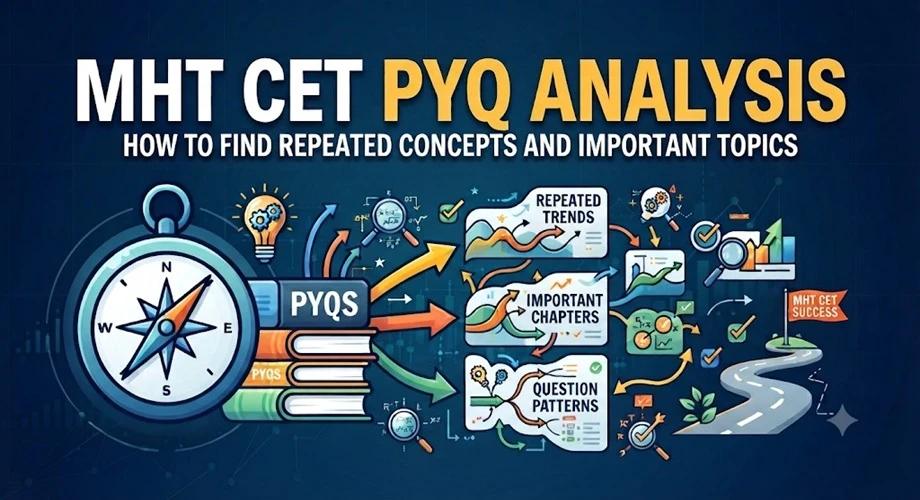
Ans: Begin solving previous year papers after completing a substantial portion of the syllabus, usually towards the end of Class 11 or early in Class 12. This helps you understand question patterns and improve time management.
7. Is the Maharashtra State Board enough for MHT CET preparation?
Ans: Yes. Maharashtra State Board textbooks form the core of MHT CET preparation. Once your concepts are clear, supplement them with MCQ practice, previous year papers, and mock tests.