

2027 is not far off, and as the new year approaches, so does MHT CET 2027. For students preparing to appear for the exam, now is the time to turn preparation into a structured plan. You need to build strong concepts, practise MHT CET-level questions, solve previous years' papers, improve speed and accuracy, and revise regularly.
Starting in July gives you enough time to cover the syllabus, practise consistently, revise, and prepare without last-minute pressure. This MHT CET 2027 roadmap covers July 2026 to April 2027, with a clear focus for each stage of preparation.
And while you're preparing for it, don't miss the updates that matter. Follow Education News by Target Publications on WhatsApp for simple, timely education updates.
MHT CET 2027 Exam Pattern
Like any other competitive exam, understanding the MHT CET exam pattern and how the exam is conducted is an important first step in your preparation. MHT CET is conducted as a Computer-Based Test (CBT) with Multiple Choice Questions (MCQs). The PCM and PCB groups have different subject combinations.
| Particulars | PCM Group | PCB Group |
| Subjects | Physics, Chemistry, Mathematics | Physics, Chemistry, Biology |
| Total Questions | 150 | 200 |
| Total Marks | 200 | 200 |
| Duration | 180 minutes | 180 minutes |
| Question Type | MCQs | MCQs |
| Negative Marking | No | No |
| Physics & Chemistry | 1 mark/question | 1 mark/question |
| Mathematics/Biology | 2 marks/question | 1 mark/question |
For the latest official exam pattern, students should refer to the MHT CET information brochure released by the Maharashtra State CET Cell.
MHT CET 2027 Preparation Tips: Month-Wise Roadmap
Now that you know the exam pattern, let's look at how you can plan your MHT CET 2027 preparation from July to April.
July–August 2026: Build a Strong Foundation
Start by understanding the MHT CET syllabus, exam pattern and your current strengths and weaknesses. Use Maharashtra State Board textbooks to strengthen your Class 11 and 12 concepts before moving into intensive practice.
Focus on:
- Covering key concepts and chapters.
- Making short formula, reaction and concept notes.
- Solving chapter-wise MCQs after completing each topic.
- Taking topic-wise practice tests to check your understanding and get familiar with the exam format.
- Setting weekly and monthly study targets.
The goal for these two months is to build strong fundamentals, not rush through the syllabus.
September–October 2026: Strengthen Concepts and Increase Practice
With your fundamentals in place, shift your focus towards syllabus coverage and regular question practice.
Focus on:
- Completing more syllabus topics.
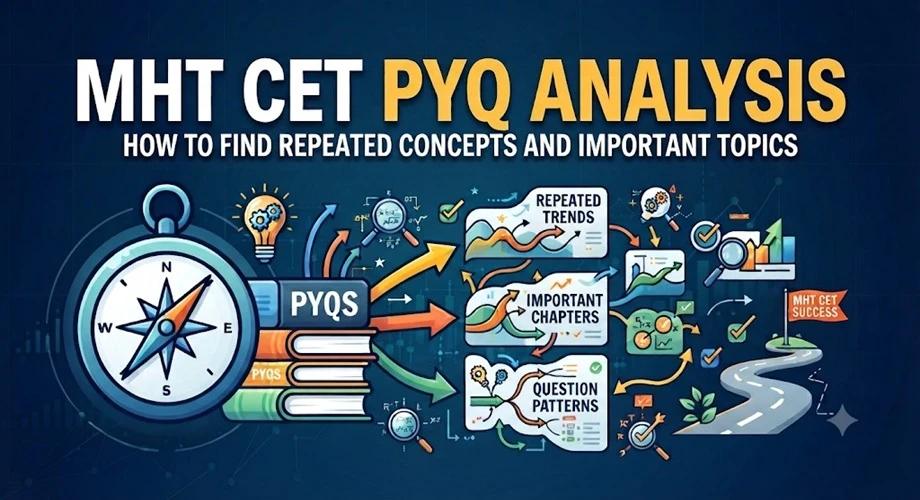
- Solving chapter-wise MCQs and MHT CET PYQs.
- Taking regular chapter-wise tests.
- Revising completed topics every week.
- Identifying weak areas and questions that take too much time.
By the end of October, identify your strengths, weak areas and the right resources including affordable MHT CET preparation books to support your preparation.
November–December 2026: Complete the Syllabus
By now, focus on finishing the syllabus and increasing your practice. Start moving from chapter-wise preparation to mixed-topic questions and tests.
Focus on:
- Completing the remaining syllabus.
- Solving MHT CET PYQs and mixed-topic MCQs.
- Taking regular mock and topic tests.
- Revising formulas, reactions and key concepts.
- Maintaining an error log and revisiting weak areas.
Aim to complete the syllabus by the end of December so you have enough time for revision and mocks.
January–February 2027: Prepare, Analyse and Balance Boards
Use these months for revision, testing and analysing your preparation, while balancing your HSC Board studies.
Focus on:
- Analyse your first-attempt performance, if applicable.
- Identify and revise weak topics.
- Review mistakes related to concepts, calculations, speed and accuracy.
- Continue regular MCQ and test practice.
- Use overlapping Board and CET topics to prepare for both exams efficiently.
Don’t stop MHT CET preparation during Boards; maintain regular MCQ practice to stay in touch with the exam.
March–April 2027: Final Revision and Second-Attempt Preparation
With the exam approaching, focus on revision, mock tests, speed and accuracy rather than learning new topics.
- Focus on:Take full-length, timed mock tests and analyse your performance.
- Solve MHT CET PYQs regularly.
- Revise formulas, reactions, short notes and weak topics.
- Work on questions that take too much time.
- Avoid starting new study material.
- Maintain a consistent sleep and study routine.
If you are appearing for a second attempt, use your first-attempt experience to target your weak areas and improve your score.
Strategic Tips for MHT CET 2027 Preparation
A good study plan works best when paired with the right strategy. Learning how MHT CET toppers approach their preparation can also help you build a more effective study routine. Keep these points in mind throughout your preparation:
1. Prioritise the Syllabus and Key Topics
Follow the official MHT CET syllabus and give due importance to both Class 11 and Class 12 topics, with greater focus on Class 12 as per the established exam pattern.
2. Follow the Learn–Practise–Test–Analyse Cycle
Study the concept, solve MCQs and PYQs, take tests, analyse your mistakes and revise. This approach is more effective than repeatedly reading the same chapters.
3. Focus on Speed and Accuracy
Practise questions under timed conditions, identify time-consuming topics and work on reducing calculation and careless errors.
4. Use Mock Tests and Both Attempts Strategically
Analyse every mock test to identify weak areas, time-management issues and recurring mistakes. If two attempts are offered for MHT CET 2027, use your first attempt as a benchmark and focus on targeted improvement for the next.
5. Keep Your Resources Limited and Revise Regularly
Stick to reliable resources such as Maharashtra State Board textbooks, MHT CET MCQs, PYQs and mock tests. Revise daily, weekly and monthly so that you don't have to relearn everything in the final months.
Important Links
Final Takeaway
A structured MHT CET 2027 preparation strategy can help you stay consistent and avoid last-minute pressure. Use July–December to build concepts and complete the syllabus, January–February for revision and analysis, and March–April for intensive practice and final revision. Focus on concepts, accuracy, speed and learning from your mistakes to make your preparation more effective.