
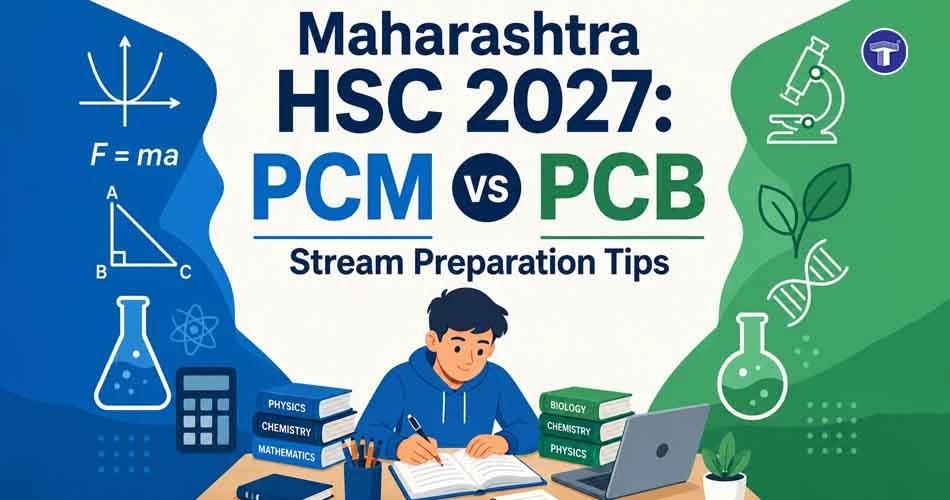
Preparing for Maharashtra HSC 2027 becomes easier when your study plan matches your Science subject combination. PCM and PCB students study Physics and Chemistry, but their third major subject changes the preparation method completely.
This blog explains how HSC PCM and HSC PCB students can prepare each subject effectively and manage HSC revision strategy while building a practical HSC study strategy. Also, we’ve shared some expert HSC study tips.
For a complete HSC planning view, read Maharashtra State Board HSC 2027 complete guide along with this PCM vs PCB strategy.
PCM vs PCB: What Is the Main Difference?
PCM and PCB are commonly used names for two Science subject combinations. PCM includes Physics, Chemistry and Mathematics, while PCB includes Physics, Chemistry and Biology.
| Preparation Area | PCM | PCB |
| Major subjects | Physics, Chemistry and Mathematics | Physics, Chemistry and Biology |
| Main practice requirement | Numericals, formulae, graphs and step-wise solutions | Concepts, diagrams, processes and scientific terms |
| Daily priority | Mathematics problem-solving | Biology reading and active recall |
| Best revision tool | Formula sheets and mistake notebooks | Flowcharts, diagrams and short notes |
Physics and Chemistry are important for both combinations. The main difference lies in how you divide your time between HSC maths preparation and HSC biology preparation. Before choosing your subject-wise routine, check MHT CET syllabus 2027 PCM and PCB guide to understand how Mathematics and Biology affect entrance preparation.
Build a Common Foundation in Physics and Chemistry
Whether you have chosen PCM or PCB, Physics and Chemistry require regular preparation. Do not study them only before tests.
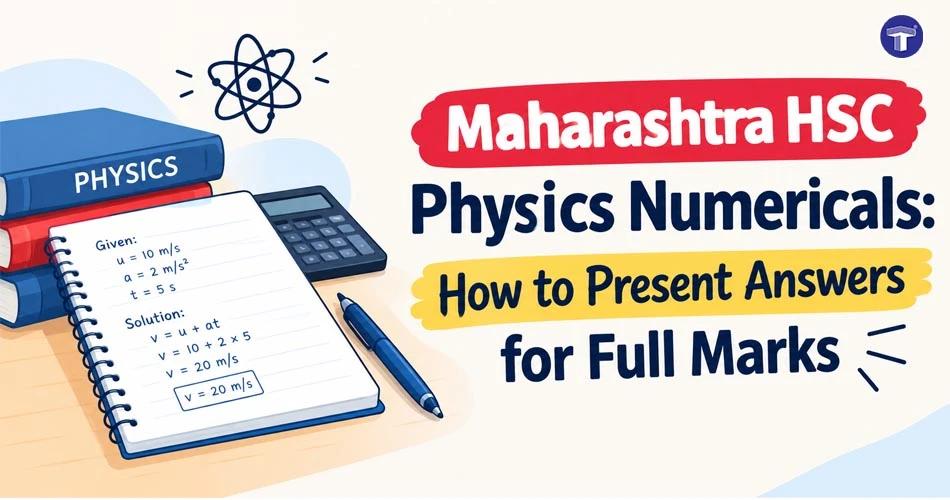
For HSC Physics preparation, understand the concept before memorising the formula. Learn what each quantity means, check the units and solve questions in a clear sequence. Begin with textbook examples and gradually move to board-style numericals.
For HSC Chemistry preparation, use separate methods for Physical, Organic and Inorganic Chemistry. Practise calculations in Physical Chemistry, create reaction maps for Organic Chemistry and prepare short comparison notes for Inorganic Chemistry.
Students studying all four subjects can use Std. 12 Science PCMB Perfect 2.0 Notes alongside their textbooks for organised revision.
HSC PCM Preparation Strategy
HSC PCM students usually have three subjects that involve calculation or application-based learning. Therefore, consistency matters more than occasional long study sessions.
Practise Mathematics Daily
HSC Mathematics preparation should be part of your daily routine if you’ve selected Class 12 Science Stream. Write all important steps instead of solving everything mentally.
Divide your practice into basic questions, standard board-style problems and mixed chapter questions. When you cannot solve a problem, identify the exact point where you became confused. Reattempt it after revising the concept.
Maintain a formula notebook, but do not depend only on memorisation. You must understand when and how each formula is applied.
Std. 12 Science PCM Perfect 2.0 Notes can be used as a supporting resource to keep Physics, Chemistry and Mathematics preparation structured.
Connect Mathematics with Physics
It is among the best HSC study techniques. Mathematical skills such as algebra, trigonometry, graphs, vectors and equation rearrangement also support HSC Physics preparation. If calculations are slowing you down in Physics, revise the required mathematical method separately.
To strengthen numerical-heavy preparation, students can refer to Std. 12 Physics Vol. 1 and 2 Precise Notes.
Avoid Numerical Overload
Solving many questions without checking mistakes is not productive. Once your method becomes effective, begin timed practice to improve speed.
While revising formulas, solved examples and common calculation methods, you can refer to Std 12 Science Mathematics - 1 Focus Notes when additional practice is needed.
HSC PCB Preparation Strategy
HSC PCB preparation requires regular reading, recall and diagram practice. Biology can become difficult when you leave detailed chapters for the final months.
Study Biology Through Active Recall
After reading a topic, close the textbook and try to explain it in your own words. Recall the steps of a process, write the important terms and redraw the related diagram. Create short notes using headings, keywords, flowcharts and comparison points.
Biology revision becomes easier when students combine diagrams, keywords, textbook questions and frequent recall practice. Std. 12 Biology Vol. 1 and 2 Precise Notes can support this routine with solved textbook questions, MCQs, PYQs and board-style practice.
Practise Diagrams Regularly
A labelled diagram should be understood, not simply copied. Learn what each part represents and how it connects with the topic. Keep label lines straight, use correct spellings and write a few related points below the figure where useful.
Revise Biology in Short Cycles
Biology needs repeated revision because chapters contain several connected facts and processes. Revise a topic on the same day, again at the end of the week and once more after a few weeks. Use flashcards for definitions and terms, flowcharts for processes and traditional notes for detailed explanations.
How to Balance HSC Board and Entrance Preparation
HSC board preparation and entrance preparation should support each other without becoming identical. Entrance preparation usually requires faster application and objective-question practice.
Study the textbook concept. Then practise board questions and objective questions separately. Do not ignore written answers simply because you are preparing for an entrance examination. If you are preparing for MHT CET, the best MHT CET books for PCM and PCB guide can help you choose subject-wise practice material.
Important Links
| 10 Things You Must Know About 12th HSC Science Board Exams | Things to Keep in Mind Before Preparing for HSC Board Examination |
Conclusion
PCM and PCB students need different approaches to HSC board preparation. PCM demands regular numerical practice, while PCB requires active recall, diagrams and repeated Biology revision.
Keep revision resources short, test yourself regularly and follow a subject-wise plan to make Maharashtra HSC 2027 preparation more organised and manageable.
FAQs
1. Is coaching compulsory for students choosing PCM or PCB?
Ans: No. Coaching is not compulsory if you understand concepts in college, study regularly and clear doubts on time. Coaching can provide additional structure, but it cannot replace textbook study, self-practice and revision.
2. What are the most common myths about choosing PCM and PCB streams?
Ans: A common myth is that PCM is only for exceptionally strong Mathematics students or that PCB depends entirely on memorisation. Both combinations require conceptual understanding, consistent practice and proper revision.
3. Which extracurricular activities can benefit PCM and PCB students during Std. 11?
Ans: Science clubs, coding, quizzes, model-making, laboratory projects and subject-related competitions can support learning. However, choose a manageable number of activities so that your regular studies are not disturbed.
4. Is it beneficial to choose the PCMB combination instead of only PCM or PCB?
Ans: PCMB may be useful when you have a genuine interest in both Mathematics and Biology. However, it creates a heavier academic workload. Choose it only after considering your interests, time and future study plans.
5. How can students improve conceptual understanding in Science subjects?
Ans: Read the textbook carefully, connect concepts with examples, draw diagrams, solve questions and explain topics in your own words. Clear doubts early and revise the concept before moving to advanced problems.