
Improving your MHT-CET score is not just about solving more questions. It also depends on understanding why you answer incorrectly and preventing the same mistakes from recurring. An error log helps you identify weak concepts, improve accuracy and make revision more effective. Instead of treating every mock test as a separate exercise, use your mistakes to build a smarter preparation strategy.
To stay updated with exam notifications and preparation resources, follow the WhatsApp channel Education News by Target Publications. You can also use the Tayari App to practise questions and assess your progress. Combining regular practice with systematic error tracking can turn every mock test into a learning opportunity.
What Is an MHT-CET Error Log?
An MHT-CET error log is a record of questions you answered incorrectly, skipped or took too long to solve. It captures the reason behind each error and the action needed to prevent it from happening again.
Effective MHT-CET error analysis helps you distinguish between conceptual gaps, calculation errors, misread questions and poor time allocation. Your goal is not to create a long list of wrong answers but to identify patterns that affect your score.
How to Build an Effective MHT-CET Error Log
1. Record Important Mistakes
After every mock test or practice session, note questions that reveal a knowledge gap or an avoidable error. Include questions you guessed correctly if you were unsure about the underlying concept.
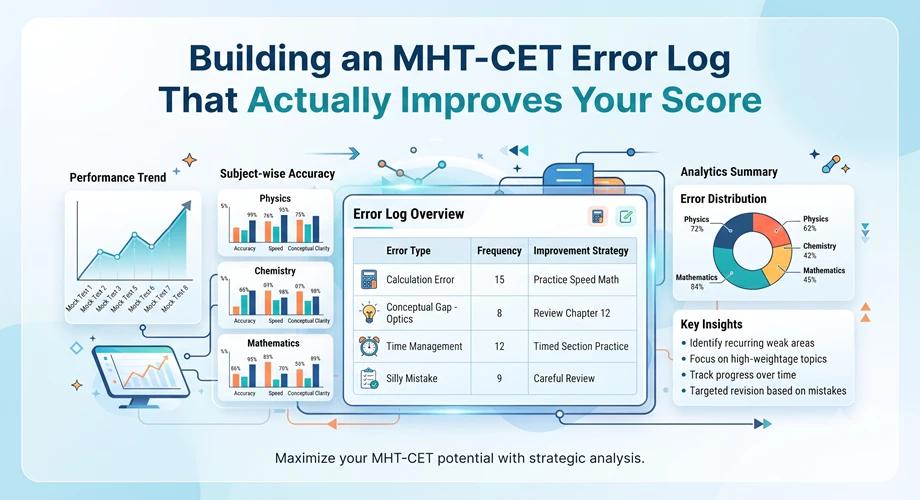
Record the subject, chapter, question number, error type, reason for the mistake, correct solution and action required. You can maintain this information in a notebook or spreadsheet as your MHT-CET study tracker.
2. Categorise Your MHT-CET Mistakes
Classifying errors helps you decide what to practise next. Use these five categories:
- Conceptual errors: You did not understand the formula, theory or principle.
- Calculation errors: You made arithmetic mistakes, missed a sign or used incorrect units.
- Question-reading errors: You overlooked words such as ‘incorrect’, ‘except’ or ‘not’.
- Time-management errors: You spent too long on a question or rushed through the paper.
- Guesswork errors: You selected an option without sufficient reasoning.
This MHT-CET mistake analysis shows whether you need conceptual revision, calculation practice or better exam techniques.
3. Identify Repeated Errors
Your MHT-CET mock test analysis should reveal mistakes that recur across different papers. For example, if you repeatedly make sign errors in Physics numericals, practise similar calculations instead of revising the entire chapter.
If you struggle with an Organic Chemistry reaction, revisit its mechanism and solve related questions. Mark recurring problems as high priority and use these findings to refine your MHT-CET strategy.
4. Turn Each Error into an Action Plan
Every entry should lead to a specific task. Replace vague instructions such as ‘revise Physics’ with measurable activities:
- Revise a formula and solve 15 related numerical questions.
- Practise 20 questions based on a difficult concept.
- Complete a timed question set to improve speed.
- Reattempt an incorrect question without checking the solution.
These practical MHT-CET preparation tips help you address your MHT-CET weak concepts without wasting time on topics you already understand.
5. Reattempt Questions Regularly
Reading a solution does not guarantee that you have understood it. Close the answer key and solve the question independently. Reattempt it after one day, three days and one week.
If you make the same mistake again, keep it on your priority list. Once you can solve the question correctly and explain the method, mark it as resolved. This routine helps you strengthen your MHT-CET weak topics and retain concepts for longer.
How to Use Your Error Log to Improve Your Score
Review your log weekly and identify the three most common sources of lost marks. If conceptual errors dominate, strengthen your fundamentals. If MHT-CET calculation errors are frequent, practise accurate calculations under timed conditions. If you leave questions unanswered, improve your question selection and MHT-CET time management.
Track repeated errors, corrected questions and subject-wise accuracy across mock tests. Your MHT-CET performance tracker should show whether your corrective actions are working.
Comparing results across several tests helps you measure MHT-CET score improvement and understand how to improve MHT-CET score through targeted practice rather than simply increasing study hours.
Important Links:
| MHT CET PYQ Analysis: How to Find Repeated Concepts and Important Topics | How to Strategize Across Both MHT-CET Attempts (April vs May): What to Change Between Sessions |
Commonly Searched FAQs About MHT-CET Error Logs
1. How do I analyse mistakes in MHT-CET mock tests?
Review incorrect, skipped and guessed questions. Categorise each error, identify its cause, revise the relevant concept and reattempt the question without checking the solution.
2. How often should I update my MHT-CET error log?
Update it after every mock test or substantial practice session. Review the complete log weekly to identify recurring errors and plan revision.
3. Should I maintain separate error logs for each subject?
You can maintain separate sections for Physics, Chemistry and Mathematics in one notebook or spreadsheet. This makes it easier to compare accuracy and identify weak chapters.
4. Can an error log improve my MHT-CET percentile?
Yes. It can help reduce repeated mistakes, improve accuracy and strengthen weak concepts. However, your percentile also depends on overall performance, exam difficulty and the applicable normalisation process.
5. What should I do if I keep repeating the same mistakes?
Revisit the underlying concept, practise similar questions and reattempt the original question after a short interval. Continue tracking the error until you can solve the question independently.
An effective error log turns every mistake into a revision task. Record your errors, identify patterns, practise targeted questions and review your progress consistently. Regular MHT-CET analysis can help you improve accuracy, strengthen weak areas and approach your next mock test with greater confidence.